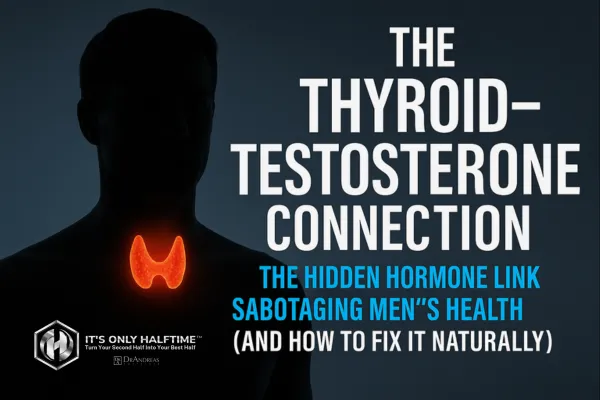
The Thyroid–Testosterone Connection: How to Fix Hormones Naturally
By Dr. Andreas Boettcher, D.C., Functional Medicine, B.S. Health/Exercise Science
3x Ironman Triathlete, Master's Men's Physique Competitor & Medication FREE at 55
Most men think low testosterone is a “testicle problem.”
But here’s the truth:
If your thyroid isn’t optimized, your testosterone will never be optimized.
The thyroid is one of the most overlooked drivers of male hormone health. This tiny gland influences your metabolism, energy, body composition, motivation, mood, and yes — the amount of testosterone your body can actually produce, activate, and use.
When the thyroid is sluggish (even slightly), testosterone follows.
When the thyroid is optimized, everything from libido to fat loss to motivation improves.
Let’s break down why this happens and what you can do about it — naturally.
SECTION 1: Why the Thyroid Is a Testosterone Powerhouse
The thyroid controls:
How much energy your cells can produce
How efficiently you burn fat
How well you convert cholesterol into testosterone
How sensitive your hormones are
How strong your mitochondria perform
How much inflammation exists in your body
How balanced your testosterone-to-estrogen ratio remains
In other words…
If the thyroid is “off,” your testosterone is working uphill — every single day.
SECTION 2: The Most Common Thyroid Patterns We See in Men — And Why They Crush Testosterone
These seven thyroid problems show up AGAIN and AGAIN in men who believe they have “low testosterone,” when in truth, their thyroid (and metabolism) have been quietly slowing down for years.
Let’s expand each one so it’s simple to understand.
1. Low Free T3 — The Real Reason You Feel Tired, Flat, and Slow
Free T3 is the active thyroid hormone.
It’s the hormone that actually enters your cells and turns energy on.
Most men with low testosterone symptoms actually have normal TSH but low Free T3— a classic under conversion issue.
When Free T3 is low, you can experience:
Fatigue no matter how much you sleep
Slow recovery
Low motivation
Brain fog
Low libido
Cold hands/feet
Lack of morning energy
Weight gain, especially around the midsection
And yes —poor testosterone performance.
Your body simply does not have the cellular energy to produce strong hormone output.
👉 This is why we often use targeted nutrients, gut repair, inflammation reduction, and — when needed — a natural desiccated thyroid support to increase Free T3 availability and boost cellular function.
2. High Reverse T3 — Your Body’s “Emergency Brake”
Reverse T3 (rT3) is a molecule your body makes when it’s stressed or inflamed.
It literally blocks T3 receptors — meaning even if you have enough T3, your cells can’t use it.
What raises Reverse T3?
Chronic stress
Poor sleep
Overtraining
Under eating
Chronic dieting
Gut inflammation
Illness or infection
Environmental toxins
Insulin resistance
When Reverse T3 goes up, men experience:
Sluggish metabolism
Crashing energy
Low libido
Fatigue in the gym
Slow muscle recovery
Symptoms that imitate “low T”
If we see high rT3, we focus heavily on stress modulation, gut repair, sleep optimization, and inflammation reduction before even considering testosterone support.
This is also a point where desiccated thyroid blends can help rebalance T3 availability naturally.
3. Elevated SHBG — The Hormone Handcuffs
SHBG (Sex Hormone–Binding Globulin) attaches to your testosterone and makes it unusable.
Think of it as putting handcuffs on your hormones.
Hypothyroidism, low T3, high estrogen, and insulin resistance all raise SHBG.
So even if your total testosterone looks good on labs, your free testosterone— the kind your body actually uses — may be extremely low.
Symptoms of high SHBG include:
Low libido
Poor morning erections
Low drive
Reduced muscle mass
Less confidence / mental sharpness
Before assuming TRT is needed, we correct the thyroid, reduce inflammation, and optimize insulin sensitivity. This alone often lowers SHBG and raises free testosterone.
👉 This is where your Ultimate Natural Testosterone Support Stack shines — especially ingredients like boron, zinc, vitamin D, adaptogens, and targeted nutrients that support free testosterone and lower SHBG naturally.
4. Subclinical Hypothyroidism — “Normal” Labs, Sluggish Body
Many men have TSH values that fall within “normal” lab ranges, yet their symptoms clearly show thyroid underperformance.
Conventional medicine aims for “not sick.”
We aim for optimal.
Functional ranges tell us:
TSH > 2.5
Low-normal Free T4
Low-normal Free T3
Cold intolerance
Weight gain
Fatigue
These are all signs the thyroid is slowing — and pulling testosterone down with it.
Subclinical hypothyroidism often responds incredibly well to:
Anti-inflammatory nutrition
Insulin optimization
Stress modulation
Micronutrient repletion
Gut healing
Desiccated thyroid support when appropriate
5. Thyroid Conversion Problems — The Gut/Liver Bottleneck
Most T4 (inactive thyroid hormone) must be converted into T3 inside:
The liver
The gut
Peripheral tissues
If either of those systems is inflamed or compromised, T3 crashes.
What blocks conversion?
Gut dysbiosis
Leaky gut
Fatty liver
Excess alcohol
High toxin exposure
Chronic inflammation
High cortisol
This is often why men feel flat, foggy, and hormonally imbalanced even with “normal labs.”
👉 This is also where the IOH GUT PROTOCOL (Read my blog here), paired with gut repair and targeted metabolic support, can significantly improve T3 activation and testosterone output at the same time.
6. Micronutrient Deficiencies — Low Iodine, Selenium, Zinc
These three minerals are essential for thyroid hormone production, activation, and protection.
Iodine→ builds thyroid hormones
Selenium→ converts T4 into active T3
Zinc→ assists hormone production, immune balance, testosterone synthesis
Deficiencies are extremely common because of:
Soil depletion
Poor digestion
Chronic inflammation
Diets low in seafood, organ meats, and minerals
High stress
Correcting these deficiencies alone can dramatically improve thyroid output and testosterone performance.
A natural desiccated thyroid supplement can also provide supportive cofactors to encourage proper thyroid metabolism.
7. Autoimmune Thyroiditis (Hashimoto’s) — The Silent Disruptor
Hashimoto’s is an autoimmune attack against the thyroid gland.
It creates unpredictable cycles:
high TSH
low T3
inflammation
weight fluctuations
emotional instability
inconsistent hormone levels
Most men with Hashimoto’s don’t know they have it.
And inflammation from Hashimoto’s drastically affects testosterone by increasing:
Aromatase → converting testosterone into estrogen
Cortisol → suppressing LH signaling
SHBG → lowering free testosterone
Mitochondrial dysfunction
The solution?
Low-inflammation nutrition, gut healing, stress modulation, toxin reduction, and supporting thyroid stability nutritionally.
Once inflammation drops, testosterone often rises.
Where Insulin Resistance & Chronic Inflammation Fit In (The Missing Puzzle Pieces)
Two metabolic issues quietly sabotage thyroid and testosterone in almost every man:
A. Insulin Resistance
When you become insulin resistant:
Thyroid conversion slows
SHBG rises
Estrogen rises
Testosterone drops
Energy production drops
Fat loss stalls
Men with central belly fat almost always have insulin resistance, which means they almost always have some level of thyroid and testosterone suppression.
That’s why the IOH nutrition approach (carnivore-based, ketogenic-inspired, low glycemic) is so effective — it restores sensitivity FAST.
B. Chronic Low-Grade Inflammation
Inflammation blocks:
Thyroid conversion
Testosterone production
LH signaling
Mitochondrial efficiency
Gut integrity
Insulin sensitivity
Inflammation is the biochemical “glue” that sticks all these problems together.
This is why any truly effective natural testosterone improvement protocol must target:
Gut health
Mitochondrial function
Nutrient density
Detoxification
Thyroid optimization
And this is exactly why your Ultimate Natural Testosterone Support Stack pairs so well with your Thyroid Support Formula— they target the two systems that control 80% of testosterone performance: metabolism and thyroid function.
The Big Picture: Fix the Thyroid → Fix the Testosterone
When men come to IOH believing they “need TRT,” here’s what we often find:
Their thyroid is underperforming
Their gut is inflamed
Their SHBG is high
Their T3 is low
Their insulin is elevated
Their Reverse T3 is high
Their estrogen ratio is off
Once we correct these systems — naturally, strategically, and predictably — their testosterone often rises on its own, even if they’ve been told “you’ll need TRT for life.”
Natural Strategies to Restore Thyroid & Testosterone (Often Allowing Men to Step Down From TRT)
1. Heal the Gut (Check out my Gut Protocol Here)
Reduces inflammation, improves conversion, supports hormone balance.
2. Improve Insulin Sensitivity
Through nutrition, strength training, and VO2 max intervals.
3. Reduce Stress & Support Adrenals
Low cortisol → poor thyroid and testosterone.
4. Replete Micronutrients
Iodine, zinc, selenium, magnesium, vitamin A, vitamin D.
5. Support Thyroid Hormone Production & Conversion
Including natural desiccated thyroid support when clinically appropriate.
6. Support Testosterone Production & Utilization
With your targeted IOH testosterone support stack (boron, zinc, vitamin D, adaptogens, mitochondrial cofactors).
7. Lower Aromatase & Improve Estrogen Detoxification
Reduce excess conversion of testosterone into estrogen. Supplements like DIM+ work exceptionally well.
8. Improve Liver Function
Supports T4 → T3 conversion and hormone clearance.
Conclusion: Most Men Don’t Have a “Testosterone Problem” — They Have a Thyroid & Metabolic Problem
Once those systems are optimized:
Testosterone rises
Free testosterone rises
SHBG stabilizes
Estrogen normalizes
Energy increases
Libido returns
Body fat drops
Confidence rises
Motivation comes back
This is what happens when men lead their biology instead of fighting it.
It’s Only Halftime — and your strongest hormonal years can still be ahead of you.
⚡️ Ready To Take Charge of Your Health With the Most Comprehensive Natural Approach to Mens Health?
If you’d like to go deeper — to uncover the root causes behind your energy, hormones, metabolism, and performance — I invite you to book a complimentary consultation.
Together, we’ll review your health history and goals and determine if our Wealthy Body Protocol based on your lab analysis, genetics, and lifestyle data is right for you!
👉 Click here to apply: limited clients accepted each quarter
To learn more about our approach and success stories, visit www.ItsOnlyHalftime.com where we help men like you turn your second half into your best half naturally!
Finish Strong,
Dr. Andreas
Still Kickin' A** Medication Free at 55 Despite What the "Narrative" Would Like You To Believe!

Medical Disclaimer:
The information provided in this article is for educational and informational purposes only and is not intended as medical advice. It should not replace professional consultation, diagnosis, or treatment. Always consult your healthcare provider before making any changes to your health regimen or lifestyle.
References
Bhasin, S., Brito, J. P., Cunningham, G. R., Hayes, F. J., Hodis, H. N., et al. (2018).Testosterone Therapy in Men With Hypogonadism: An Endocrine Society Clinical Practice Guideline.Journal of Clinical Endocrinology & Metabolism.
Gagnon, A., & Gagnon, A. M. (2011).Leptin, the Hypothalamic-Pituitary-Gonadal Axis, and the Regulation of Testicular Function.Molecular and Cellular Endocrinology.
Iwen, K., Schröder, E., & Brabant, G. (2013).Thyroid Hormones and the Metabolic Syndrome.European Thyroid Journal.
Mullur, R., Liu, Y-Y., & Brent, G. A. (2014).Thyroid Hormone Regulation of Metabolism.Physiological Reviews.
De Pergola, G., & Giagulli, V. A. (2011).Thyroid Hormones and Sex Hormone Binding Globulin.Journal of Endocrinological Investigation.
Carrozza, M., Catapano, G., et al. (2010).Hypothyroidism and Hormonal Changes in Men.Journal of Endocrinological Investigation.
Simó, R., Saez-Lopez, C., Barbosa-Desongles, A., Hernandez, C., & Selva, D. M. (2015).Novel Insights in SHBG Regulation and Clinical Implications.Trends in Endocrinology & Metabolism.
Tomlinson, J. W., & Stimson, R. H. (2013).Leptin and the HPA–HPG Axis.Best Practice & Research Clinical Endocrinology & Metabolism.
Wartofsky, L., & Burman, K. D. (2002).Alterations in Thyroid Function in Patients with Systemic Illness: The Nonthyroidal Illness Syndrome.Endocrine Reviews.
Escobar-Morreale, H. F., & Morán, C. (2011).Role of Thyroid Dysfunction in Metabolic Disorders.Thyroid Research.
Nystrom, H. F., Brantsaeter, A. L., et al. (2016).Iodine, Thyroid Function, and Fertility.Thyroid.
Rayman, M. P. (2012).Selenium and Human Health.The Lancet.
Prasad, A. S. (2012).Zinc Deficiency and Its Clinical Implications.Journal of Trace Elements in Medicine and Biology.
Pearce, E. N., Farwell, A. P., & Braverman, L. E. (2003).Thyroiditis and Autoimmune Thyroid Disease.New England Journal of Medicine.
Chaker, L., Bianco, A. C., Jonklaas, J., & Peeters, R. P. (2017).Hypothyroidism.The Lancet.
Corona, G., Pizzocaro, A., et al. (2013).Testosterone and Metabolic Syndrome: A Meta-Analysis Study.Journal of Sexual Medicine.
Pittaway, D. E., Schuessler, G., & Davis, A. (1998).The Effect of Thyroid Dysfunction on Male Reproductive Hormones.Fertility and Sterility.
Tremellen, K., & Pearce, K. (2012).Gut Microbiota Dysfunction and Inflammation in Hypogonadism.Medical Hypotheses.
Zhao, L., & Zhang, F. (2019).Gut–Thyroid Axis: How Intestinal Dysbiosis Influences Thyroid Function.Endocrine.
Hotamisligil, G. S. (2017).Inflammation, Metaflammation, and Insulin Resistance.Nature Reviews Immunology.
Kelley, D. E., & Goodpaster, B. H. (2001).Skeletal Muscle Insulin Resistance and Lipotoxicity.Annals of the New York Academy of Sciences.
Feingold, K. R., & Grunfeld, C. (2012).The Effect of Inflammation and Inflammatory Mediators on Lipid and Lipoprotein Metabolism.Endotext.
Jonklaas, J., Burman, K. D., et al. (2018).Thyroid Hormone and Replacement Therapy: Clinical Considerations.Endocrine Reviews.
Barbesino, G. (2015).Misdiagnosis of Thyroid Disorders When Using Standard TSH Testing.Clinical Chemistry.
Duntas, L. H., & Popovic, V. (2013).Thyroid and Reproduction: A Clinical Overview.Journal of Thyroid Research.