Why TRT Causes Side Effects—And How Fixing Root Causes Restores Testosterone
By Dr. Andreas Boettcher, D.C., Functional Medicine, B.S. Health/Exercise Science
3x Ironman Triathlete, Master's Men's Physique Competitor, Medication Free at 55
Why TRT Causes Side Effects in Men — And the Truth About What’s Really Driving Low Testosterone Today
Walk into any men’s clinic today and you’ll find the same story:
“Low T? Here’s your gel, your pellets, or your injections. You’ll feel amazing.”
And many men do feel better—at first.
But weeks or months later, countless men report bloating, mood swings, elevated hematocrit, acne, fatigue, gynecomastia, blood pressure issues, disrupted sleep, or a rollercoaster of highs and lows. They were promised “optimization”… but ended up managing a new set of problems.
So what’s going on?
Why does TRT create so many side effects for modern men?
The real answer isn’t simply “testosterone replacement.”
The real answer is the biology you’re putting it into.
In this article, you’re going to learn:
Why TRT often amplifies underlying dysfunctions
The root causes behind the majority of low-T cases
Why the TRAVERSE study gave only part of the picture
And how you can reclaim testosterone naturally by restoring the upstream systems that make it
This is the truth most clinics skip right over—because fixing the terrain takes more effort than writing a prescription.
But at It’s Only Halftime, we’re here for root cause.
We’re here for optimization.
We’re here for the second half of your life to become your strongest half.
Let’s dive in.
The Problem Isn’t TRT — It’s What TRT Walks Into
Testosterone therapy in isolation isn’t inherently “dangerous.”
In fact, the large TRAVERSE trial—the biggest testosterone study to date—found that TRT was not associated with more heart attacks, strokes, or cardiovascular deaths compared to placebo.
👉🏻 Click here to read my review of the Traverse Trial Conclusions, Strengths & Weaknesses
But the headlines left out something important:
The study only looked at transdermal gels
The men were meticulously screened
The men were tightly monitored
And even then, the TRT group still experienced more atrial fibrillation, pulmonary embolism, and acute kidney injury
So while TRT isn’t a heart attack bomb, it’s also not a “free ride.”
Why?
Because testosterone is an amplifier, not a band-aid.
It turns up whatever is happening inside your body—good or bad.
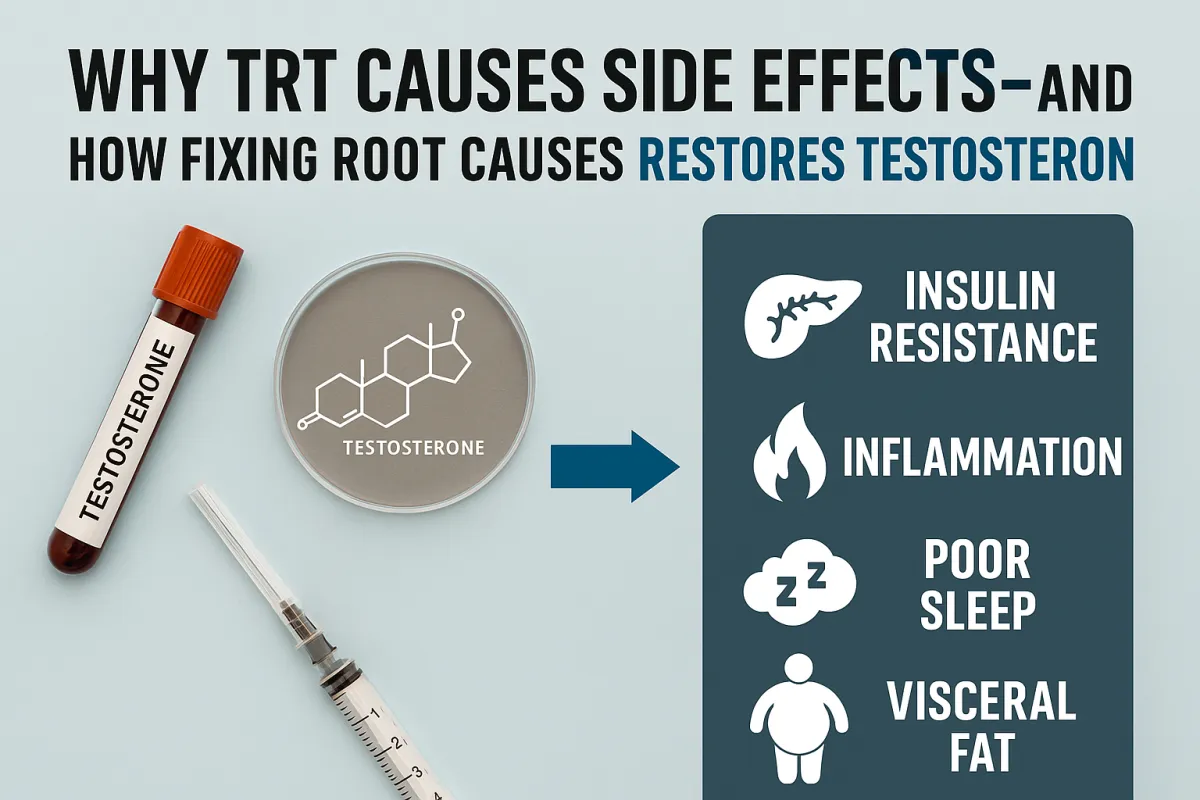
If you take a metabolically unhealthy man and pour testosterone into a system full of inflammation, visceral fat, insulin resistance, aromatase activity, and poor sleep…
…you don’t fix the problem.
You give the problem more horsepower.
The REAL Causes of Low Testosterone Today
Most men aren’t “testosterone deficient.”
They’re metabolically suppressed.
Here are the true drivers—validated in research and seen daily across your lab work in the Peak Performance Protocol.
1. Insulin Resistance: The #1 Testosterone Killer
Insulin resistance and low testosterone form a vicious cycle:
Low T → more visceral fat
More visceral fat → more insulin resistance
Insulin resistance → suppressed LH/FSH
Suppressed LH/FSH → reduced testicular testosterone
Reduced T → even more fat gain
This is the modern health spiral.
And here’s the kicker:
Visceral fat is aromatase-rich.
Aromatase converts testosterone into estradiol.
So the more fat you carry, the more your own testosterone gets turned into estrogen before your body can use it.
This isn’t a TRT problem.
This is a metabolic problem.
2. Chronic Low-Grade Inflammation: The Silent Saboteur
Inflammatory cytokines like IL-6 and TNF-α—driven by obesity, poor diet, poor sleep, stress, alcohol, and inactivity—directly impair:
Leydig cell testosterone production
Hypothalamic (GnRH) output
Pituitary (LH/FSH) signaling
Inflammation literally turns down your hormonal thermostat.
Prescription testosterone doesn’t solve that.
It simply pours hormone into a damaged signaling system.
3. Excess Body Fat & Aromatase: The Estrogen Factory
The heavier you are around your midsection, the more estrogen you will make—whether that testosterone is coming from your testicles or a vial.
More substrate → more estradiol.
More estradiol → more feedback suppression.
More suppression → lower endogenous T.
This is why overweight men often complain that TRT made them feel “more emotional,” “bloated,” or “puffy.”
It didn’t.
Aromatase did.
4. Poor Sleep & Sleep Apnea: A Hormonal Wrecking Ball
One week of sleeping 5 hours per night—just one—can drop a man’s testosterone 10–15%.
Chronic sleep loss
snoring
apnea
late-night screens
stress-driven insomnia
= hormonal collapse
TRT doesn’t fix sleep.
But poor sleep will absolutely dictate how your body responds to TRT.
5. Processed Foods, Nutrient Gaps, and the Modern Diet
Ultra-processed foods drive every mechanism that destroys testosterone:
Insulin resistance
Liver fat
Inflammation
Micronutrient deficiencies (zinc, magnesium, vitamin D)
Oxidative stress
Mitochondrial dysfunction
Low testosterone is a symptom of that lifestyle.
So is every “side effect” that gets blamed on TRT.
So What Actually Causes TRT’s Side Effects?
Here is the truth men are never told:
TRT doesn’t cause most side effects. The underlying biology does. TRT just magnifies it.
1. Elevated Estradiol
Not because TRT is bad — but because aromatase is high from visceral fat.
2. Water Retention, Mood Swings, Gynecomastia
Not because testosterone is “dangerous” — but because fatty tissue is converting more T → E2.
3. High Hematocrit
Testosterone increases red blood cell production, but the risk comes from pairing that with:
Poor hydration
High insulin
Inflammation
Sleep apnea
Vascular stiffness
4. High Blood Pressure
The FDA now requires a blood pressure warning on many TRT products for a reason.
If your metabolism is unhealthy, TRT increases volume, drive, activity, and demand—stacked on top of a fragile system.
5. Testicular Suppression
TRT shuts down LH/FSH.
If you never correct the root causes of low T, you become dependent.
Here Is the Functional Medicine Truth:
Fix the system, and testosterone rises naturally.
Fix the system, and side effects disappear.
Fix the system, and TRT becomes a tool (if necessary at all) — not a crutch
When you optimize:
insulin
inflammation
visceral fat
sleep
nutrient density
mitochondrial function
training
recovery
…the male body wants to produce testosterone.
This is why so many men in the Peak Performance Protocol see:
Higher testosterone
Better estradiol ratios
Lower inflammation
Lower visceral fat
More energy
Better focus
Stronger libido
Lower blood pressure
Better sleep
Better biomarkers
…all without a single injection.
The Bottom Line: TRT Isn’t the Villain — Your Terrain Is
If you’re metabolically healthy, lean, insulin-sensitive, well-rested, and inflammation-free, TRT can be incredibly safe and beneficial.
But most men aren’t starting there.
And that’s why the side effects show up.
TRT is like adding horsepower to a car with worn tires, bad alignment, old oil, and a failing transmission.
It won’t fix the foundation.
It will expose it.
The Smarter Approach for Men Who Want Real Optimization
Before considering TRT, every man should:
Improve metabolic flexibility
Reduce inflammation
Lose visceral fat
Strengthen mitochondrial function
Restore sleep quality
Clean up diet
Address stress
Support natural testosterone pathways
If TRT is still needed afterward, it becomes:
Safer
Smoother
More effective
Longer lasting
And dramatically lower in side effects
However, in my experience, over 80% of men will never need TRT when they address the terrain FIRST!
This is the strategy we use every single day inside the Peak Performance Protocol — and it’s the reason men in their 40s, 50s, and 60s are reporting the best energy, confidence, labs, and physiques of their lives.
If You’re Ready to Fix the Terrain and Reclaim Your Testosterone the Right Way…
Then it’s time.
Time to stop chasing shortcuts.
Time to stop outsourcing your biology.
Time to stop relying on band-aids.
Time to fix the systems that age you prematurely and steal your hormonal power.
Your second half can absolutely be your strongest — but only if you build it on a strong foundation.
If you’re ready to discover what’s truly possible when you optimize your biology from the inside out,
book your Peak Performance Consultation and start your transformation.
Because it’s only halftime…
And the comeback is about to begin.
⚡️ Ready To Fix the Terrain With the Most Comprehensive Natural Approach to Mens Health?
If you’d like to go deeper — to uncover the root causes behind your energy, hormones, metabolism, and performance — I invite you to book a complimentary consultation.
Together, we’ll review your health history and goals and determine if our Peak Performance Protocol based on your lab analysis, genetics, and lifestyle data is right for you!
👉Click here to schedule your complimentary consultation.
To learn more about our approach and success stories, visit www.ItsOnlyHalftime.com where we help men like you turn your second half into your best half naturally!
Finish Strong,
Dr. Andreas
Still Kickin' A** Medication Free at 55 Despite What the "Narrative" Would Like You To Believe!

Medical Disclaimer:
The information provided in this article is for educational and informational purposes only and is not intended as medical advice. It should not replace professional consultation, diagnosis, or treatment. Always consult your healthcare provider before making any changes to your health regimen or lifestyle.
References
Lincoff AM, et al.Cardiovascular Safety of Testosterone-Replacement Therapy in Men with Hypogonadism.New England Journal of Medicine. 2023.
Hackett GI.Long-Term Cardiovascular Safety of Testosterone Therapy.Therapeutic Advances in Endocrinology and Metabolism. 2024.
Lincoff AM, et al. TRAVERSE Trial Correspondence and Safety Discussion. New England Journal of Medicine. 2023.
FDA Testosterone Product Labeling Update. U.S. Food & Drug Administration. 2025.
Wang C, et al.Low Testosterone Associated With Obesity and the Metabolic Syndrome.Asian Journal of Andrology. 2011.
Muraleedharan V, Jones TH.Testosterone and the Metabolic Syndrome.Translational Andrology and Urology. 2010.
Muir CA, et al.Low Testosterone Concentrations in Men With Obesity: Importance of Weight Loss.Journal of Clinical Endocrinology & Metabolism. 2025.
Khalil SHA, et al.Diabetes Surpasses Obesity as a Risk Factor for Low Serum Testosterone.Diabetology & Metabolic Syndrome. 2024.
Fernandez CJ, et al.Male Obesity-Related Secondary Hypogonadism: Pathophysiology, Clinical Implications and Management.Nature Reviews Endocrinology. 2019.
Minuzzi RK, et al.The Role of Hypogonadism in the Body Composition of Men With Obesity.Obesity Medicine. 2024.
Facchiano E, et al.Body Weight Loss Reverts Obesity-Associated Hypogonadotropic Hypogonadism: A Systematic Review and Meta-Analysis.European Journal of Endocrinology. 2013.
Corona G, et al.Obesity and Late-Onset Hypogonadism.Best Practice & Research Clinical Endocrinology & Metabolism. 2015.
Escobar-Morreale HF, et al.Prevalence of Obesity-Associated Gonadal Dysfunction and its Reversal After Bariatric Surgery.Human Reproduction Update. 2017.
Miñambres I, et al.Obesity Surgery Improves Hypogonadism and Sexual Function in Men.Journal of Clinical Medicine. 2022.
Giagulli VA, et al.The Role of Diet and Weight Loss in Improving Secondary Hypogonadism in Men With Obesity.Nutrients. 2019.
Shenoy MT, et al.Management of Male Obesity-Related Secondary Hypogonadism: A Clinical Update.World Journal of Men’s Health / Obesity Research & Clinical Practice. 2024–2025.
Corona G.Treatment of Functional Hypogonadism Besides Testosterone.World Journal of Men's Health. 2020.
Sultan S, et al.Male Obesity-Associated Gonadal Dysfunction and the Role of Bariatric Surgery.Frontiers in Endocrinology. 2020.
Jensterle M, et al.Effects of Liraglutide on Obesity-Associated Functional Hypogonadism.Endocrine Connections. 2019.
Leproult R, Van Cauter E.Effect of One Week of Sleep Restriction on Testosterone Levels in Young Healthy Men.JAMA. 2011.
Su L, et al.Effect of Partial and Total Sleep Deprivation on Serum Testosterone: A Meta-Analysis.Sleep Medicine. 2021.
Crisóstomo L, et al.Lifestyle, Metabolic Disorders, and Male Hypogonadism.Best Practice & Research Clinical Endocrinology & Metabolism. 2020.
Grossmann M, et al.Evaluation and Management of Men ≥50 Years With Low Testosterone.Journal of Clinical Endocrinology & Metabolism. 2023.
Grossmann M.Hypogonadism and Male Obesity: Focus on Unresolved Questions.Clinical Endocrinology (Oxford). 2018.
Lenart-Lipińska M, et al.Clinical and Therapeutic Implications of Male Obesity.Journal of Clinical Medicine. 2023.
ENDO 2025 GLP-1 Male Testosterone Findings. Endocrine Society Annual Meeting. 2025.