

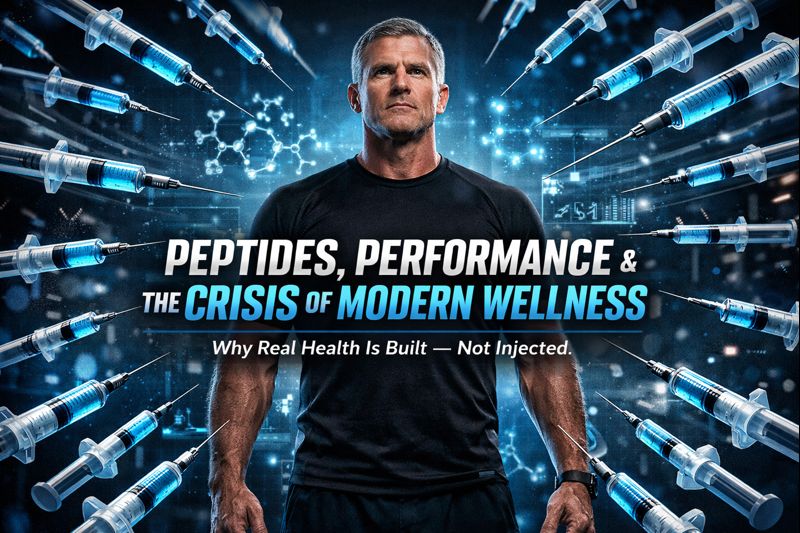
Peptides and Men’s Health: The Truth Behind the Hype, the Science, and the Real Path to Peak Performance Blog Post
By Dr. Andreas Boettcher, D.C., Functional Medicine, B.S. Health/Exercise Science
3x Ironman Triathlete, Master's Men's Physique Competitor - Medication & Peptide FREE at 55
A Clinical, Evidence-Based Examination of What’s Real, What’s Promising — and What Has Gone Completely Off the Rails
Open your phone.
Scroll for sixty seconds.
And it’s impossible not to see it.
Another peptide ad.
Another influencer holding a syringe.
Another promise whispered directly into a man’s uncertainty.
“Inject this.”
“Stack that.”
“This is why you’re tired.”
“This is why you’re aging.”
“This is the missing link.”
“This is the panacea.”
And every time I see it, I feel the same reaction — not curiosity, not excitement — but something much deeper.
A pit in my stomach.
Because what I’m watching unfold is not the evolution of health.
It’s the commercialization of desperation.
Once again, men are being told that the reason they feel broken is because they’re missing something outside of themselves — and conveniently, the solution is always available for purchase.
For decades, much of conventional medicine focused almost exclusively on disease management.
Manage blood sugar.
Manage cholesterol.
Manage blood pressure.
Manage symptoms.
Now many of those same systems have simply rebranded.
The language has changed.
The dependency has not.
Today, the message sounds far more modern — far more sophisticated — but at its core, it’s eerily familiar:
“You’re tired because you lack this peptide.”
“You’re overweight because your hormones aren’t optimal.”
“You’re aging because your body doesn’t produce enough of something we can now inject.”
That is not wellness.
That is disease management wearing a new outfit.
True wellness is not something you receive.
It is something you build.
And what makes a man healthy is not what he injects — it’s what he does, consistently, when no one is watching.
The work.
The discipline.
The structure.
The ownership.
That is what produces independence.
And independence — not perpetual treatment — is the highest form of health.
From a physiological standpoint, peptides are not imaginary. They are real biological signaling molecules.
Short chains of amino acids that bind to receptors and influence downstream pathways involved in inflammation modulation, insulin signaling, immune activity, tissue repair, appetite regulation, and growth hormone–IGF-1 communication.
This is legitimate biology.
Modern medicine already uses peptide-based therapies in highly specific, regulated contexts.
Where the conversation breaks down is when peptides are marketed as foundational solutions rather than adjunctive tools.
From a systems-biology perspective, this is a critical misunderstanding.
Peptides do not fix upstream dysfunction.
They operate downstream.
Which means they do not create health — they modulate the terrain that already exists.
You cannot signal a broken system into wellness.
You must first repair the system itself.
The peptide market is really 2 different universes
Universe A: FDA-approved peptide drugs (strongest human data)
Examples:
GLP-1/GIP peptides (e.g., semaglutide/tirzepatide—technically peptides/peptide-based therapeutics). These have large RCT programs and clear outcomes (weight loss, glycemic control). The current controversy is not “do they work?”—it’s access + compounding + gray-market sourcing, which FDA has been actively warning about.
Tesamorelin (Egrifta) for HIV-associated lipodystrophy: multiple trials show reduction in visceral adipose tissue; meta-analytic work exists, but long-term outcome/safety questions remain, especially related to IGF-1 elevation and malignancy precautions in labeling.
Bremelanotide (Vyleesi, PT-141 class) is FDA-approved for HSDD in premenopausal women, with clinical trial evidence and known adverse effects.
Bottom line:In Universe A, there’s real evidence and regulated manufacturing—your discussion becomes about appropriate indications, monitoring, and risk-benefit.
Universe B: “Wellness / performance” injectable peptides (weakest human data)
The big names here: BPC-157, TB-500 / thymosin beta-4 fragments, CJC-1295, ipamorelin, ibutamoren, MOTS-c, kisspeptin-10, melanotan II, PEG-MGF, etc.
This is where:
Human trials are often small, scarce, not replicated, or absent.
Quality control is highly variable.
Most claims are extrapolated from animals, mechanisms, or anecdotes.
FDA has explicitly flagged several of these for potential safety risks and limited human safety information, including issues like immunogenicity/impurities and lack of exposure data for proposed routes.
And this is also where you see the “human pincushion” stacks.
“Most common peptides” people are using—and what the data actually says
1) Injury repair / “heal faster” peptides (BPC-157, TB-500 family)
Claim: tendon/ligament/muscle healing, faster recovery.
Evidence reality:
For BPC-157, reviews in sports medicine consistently note robust animal data but very limited human evidence, with gaps in human safety data.
This is exactly the category where many products are sold as “research use only,” while being marketed for human use—raising both legal and quality concerns (purity/contamination/dosing).
Practical interpretation: If someone won’t do the boring basics (sleep, protein targets, progressive loading, inflammation/insulin control), these peptides rarely “save” the outcome—consistent with what you’ve seen clinically.
2) Growth hormone secretagogues (CJC-1295, ipamorelin, sermorelin, ibutamoren/MK-677; tesamorelin is a prescription category)
Claim: fat loss, recovery, sleep, lean mass, “anti-aging.”
Evidence reality:
CJC-1295 has controlled human data showing it can stimulate GH/IGF-1 physiology (pharmacodynamics), but that’s not the same as proving long-term outcomes like longevity, performance, or body comp transformation in typical “wellness users.”
A medical review of growth hormone secretagogues highlights that many are not FDA approved (not that I have much faith in the FDA - topic for another day) and have been marketed as supplements or sold online, emphasizing the regulatory gray-zone.
Tesamorelin is the “cleanest” in this family from a data/regulatory standpoint (approved indication), but even there, labeling highlights monitoring IGF-1, unknown long-term effects of sustained elevations, and discontinue if recurrent malignancy.
Your angiogenesis / cancer concern (important nuance)
Your concern is biologically plausible and is exactly why this topic needs adult supervision:
IGF-1 signaling is mechanistically linked to cancer biology (proliferation, survival signaling, invasion, etc.).
That does not automatically prove “GH peptides cause cancer,” but it supports a cautious stance—especially in higher-risk individuals or anyone with unknown malignancy, strong family history, prior cancers, or unexplained symptoms.
Clinically responsible positioning:“If you’re going to manipulate GH/IGF-1, you’d better have a reason, baseline screening, and monitoring—this isn’t a biohack toy.”
3) Immune modulation peptides (Thymosin alpha-1)
Claim:immune optimization, resilience, anti-viral, “anti-inflammation.”
Evidence reality:
Thymosin alpha-1 has legitimate clinical research history and has been studied in infections/immune states; there are systematic reviews and trials (e.g., sepsis), but results are not uniformly “slam dunk.”
Interpretation:This is a real biologic with real immunology—but it’s not a general “make me superhuman” peptide. Indication, timing, patient selection matter.
4) Cosmetic peptides (topical copper peptide GHK-Cu)
Claim:skin quality, collagen support, repair.
Evidence reality:
There is supportive clinical/dermatology literature and some human trials—mostly topical, lower systemic risk than injectable “performance stacks.”
The biggest risk isn’t “the peptide”… it’s the sourcing + sterility + impurities
If a product is:
“research use only”
mixed/reconstituted at home
from an online vendor
or compounded under questionable conditions
…then the risk profile changes dramatically.
Why you brought up LPS/endotoxin (you’re right to)
Endotoxin (LPS) contamination can trigger powerful inflammatory reactions even when a product is sterile. FDA has extensive inspection guidance on endotoxins/pyrogens because this is a real parenteral risk.
And LPS contamination is common enough in non-clinical materials that it’s a known problem in research reagents.
Translation for your audience:“Even if it ‘looks legit,’ impurities can turn your ‘recovery peptide’ into an inflammation injection.”
Unbiased summary: what the totality of data suggests
What peptides can do (when evidence is real)
Some peptides are legitimate medicines (metabolic, endocrine, sexual health, immune contexts) with RCT-backed effects and known risks.
What peptides cannot do (no matter what the guru says)
They do not override insulin resistance, sleep debt, alcohol, ultra-processed diet, low protein, sedentary lifestyle, chronic stress, and excess body fat.
Theydon’t fix an identity problem: inconsistency, poor planning, and lack of execution.
This lines up with your real-world observation: clients who used peptides without the foundation often got…nothing.
And this brings us to the part that truly concerns me.
The human pin cushion problem.
I watch influencers online injecting TRT…
then a growth hormone peptide…
then a fat-loss peptide…
then a recovery peptide…
then another stack layered on top of that stack.
Daily injections.
Weekly injections.
Endless injections.
All sold as the panacea for optimal health.
And I find myself thinking:
Please… stop the insanity.
I have no desire — none — to turn myself into a human pin cushion chasing marginal gains.
Especially when those gains are being promised without long-term human data.
Here’s the irony that no one wants to talk about.
I’m 56 years old.
I don’t use peptides.
I don’t run stacks.
I don’t live tethered to a syringe.
Yet my labs are optimal.
My energy is high.
My recovery is strong.
My performance is excellent.
My metabolic age is in my 30s.
And even more importantly — I see these same results in clients.
Men reclaiming energy.
Reducing inflammation.
Reversing insulin resistance.
Dropping visceral fat.
Restoring vitality.
Without turning themselves into human pin cushions.
That alone should make every man pause.
Here is the truth the peptide industry rarely acknowledges:
Nearly every “profound benefit” being promised by peptides can be achieved — and often surpassed — through restored physiology.
✅ Energy improves when insulin sensitivity improves.
✅ Fat loss follows metabolic flexibility.
✅ Recovery improves when inflammation decreases.
✅ Hormones rebalance when sleep architecture is restored.
✅ Muscle preservation improves with sufficient protein and intelligent training.
✅ Mental clarity improves when blood sugar stabilizes and inflammation resolves.
These are not hacks.
These are biological laws.
The human body already produces the very signaling molecules peptides attempt to mimic.
They decline not because aging is inevitable — but because lifestyle suppresses them.
Chronic hyperinsulinemia blunts hormonal signaling.
Visceral fat drives inflammatory cytokines.
Sleep deprivation suppresses natural GH pulses.
Alcohol disrupts endocrine function.
Micronutrient deficiencies impair enzymatic pathways.
Sedentary behavior deconditions mitochondria.
Restore the upstream terrain — and the body does what it was designed to do.
Heal.
Adapt.
Regulate.
Perform.
No needle required.
This is exactly what we do inside the Peak Performance Protocol.
We don’t chase outcomes.
We restore systems.
Through lifestyle modification.
Through precision nutrition.
Through intelligent training.
Through strategic supplementation.
Through nutrigenomics and genetic testing.
Not guessing — understanding.
By identifying inflammatory predispositions, detox capacity, methylation efficiency, insulin sensitivity risk, stress-response patterns — we tailor the inputs that allow the body to self-regulate.
That is real precision medicine.
Not forcing signals into the body.
Supporting its ability to regulate itself.
Self-regulation is health.
Dependency is not.
THE IOH PROGRESSION
Level 1: Foundation (non-negotiable)
insulin sensitivity + inflammation control
training as medicine
sleep and recovery
body composition momentum
labs + accountability
Level 2: Optimization (select tools)
targeted nutrition timing, VO₂ max structure, supplementation fundamentals, biomarkers
Level 3: Advanced strategies (peptides belong here IF EVER!)
Only after:
baseline labs + risk stratification
clear indication and measurable outcome target
sourcing standards
monitoring plan
exit strategy (no endless stacking)
And your line—delivered straight:
“Peptides are an amplifier, not a rescue mission.”
A clinician-grade “rules to lift by” for peptide decisions
If you want a simple decision filter you can teach:
Green-light questions
What is the exact indication? (not “anti-aging”)
What objective marker are we changing? (DEXA, A1c, ALT, IGF-1, symptoms + validated scales, etc.)
What’s the evidence tier? FDA-approved / RCT / small human / animal only / anecdote
What’s the monitoring plan + stop rules?
What’s the sourcing and sterility assurance?
Red flags
“Stacking” 4–8 injectables with no labs
“Research use only” sold as human therapy
No plan for IGF-1 monitoring when playing with GH pathways
Using peptides to compensate for poor execution (diet/training/sleep)
My Prediction in a World Drowning in Quick Fixes
You don’t even have to believe me.
In fact, I’d encourage you not to.
Just look at the trends.
Look back over the last 20, 30, 40 years.
Every decade brings a new miracle.
A new biohack.
A new shortcut.
A new breakthrough.
A new promise that this time — finally — we’ve cracked the code.
Low-fat diets.
Low-carb diets.
Fat burners.
Thermogenics.
Hormone creams.
Testosterone clinics.
Injectables.
Peptides.
Stacks on stacks on stacks.
And yet… here we are.
Obesity continues to skyrocket.
Type 2 diabetes continues to rise.
Insulin resistance is now the norm, not the exception.
Chronic inflammation is everywhere.
Energy is lower.
Performance is worse.
Men feel older at 40 than their fathers did at 60.
If quick fixes worked, we would not be here.
If more molecules were the answer, we would be the healthiest society in human history.
We are not.
And that alone should force a moment of honesty.
Here is my prediction — and I say this without emotion, without agenda, and without fear of being unpopular:
Even with peptides everywhere… obesity will continue to rise.
Chronic disease will continue to rise.
Metabolic dysfunction will continue to rise.
Not because the tools are useless.
But because tools do not change behavior.
And behavior — not biology — is what ultimately determines outcomes.
You cannot out-inject a poor lifestyle.
You cannot out-stack insulin resistance.
You cannot biohack discipline.
And no peptide can override an environment that constantly works against health.
The current peptide boom — especially in the unregulated “wellness” and influencer space — looks less like a revolution and more like a familiar cycle repeating itself.
The same old story.
A new coat of paint on the same promise:
“This time, you won’t have to do the work.”
History tells us how that story ends.
Every time.
And let me be very clear about something.
I refuse to compromise my values for a quick buck. Lord knows I could make a lot of MONEY subscribing you to injections and peptides.
I refuse to sell men what they want to hear at the expense of what they need to hear.
And I refuse — absolutely refuse — to gamble with my own health chasing trends when the fundamentals already work.
Because the truth is not exciting.
But it is liberating.
Health is not found in shortcuts.
It is built through ownership.
Through structure.
Through discipline.
Through consistency.
Through doing the work — even when it’s not glamorous, even when it’s not viral, even when it doesn’t sell as fast.
That is the difference between influence and leadership.
And that is why, in a sea of quick fixes, I choose the harder path.
Because it’s the only one that actually leads somewhere.
And this leads to the statement that many men resist — but eventually accept:
There is no shortcut to health.
Period.
End of story.
Anyone telling you otherwise is selling you what you want to hear — not what you need to hear.
Health cannot be outsourced.
It must be owned.
The work is what makes you healthy.
Not temporarily.
Not cosmetically.
But permanently.
That truth may not trend — but it endures.
This is not an anti-peptide stance.
It is a pro-discipline stance.
Science evolves.
Data matures.
What lacks clarity today may earn its place tomorrow.
I am open to that.
I am watching the research.
But I refuse to let marketing outrun medicine.
I refuse to let fear dictate physiology.
And I refuse to teach men that the path to health runs through a needle.
Peptides, if they belong anywhere, belong at the very top — as advanced, selective tools used only after the foundation has been built.
Never before it.
Never instead of it.
Because peptides do not build health.
They amplify it.
And amplification without a foundation only magnifies dysfunction.
There is a better way.
A quieter way.
A sustainable way.
One built on structure, ownership, and respect for biology.
Not desperation masked as optimization.
That is the IOH standard.
That is what we teach.
That is what we live.
Because the work still works.
And it always will.
⚡️ Ready To Take Charge of Your Health With the Most Comprehensive Natural Approach to Mens Health?
If you’d like to go deeper — to uncover the root causes behind your energy, hormones, metabolism, and performance — I invite you to book a complimentary consultation.
Together, we’ll review your health history and goals and determine if our Wealthy Body Protocol based on your lab analysis, genetics, and lifestyle data is right for you!
👉 Click here to apply: limited clients accepted each quarter
To learn more about our approach and success stories, visit www.ItsOnlyHalftime.com where we help men like you turn your second half into your best half naturally!
Finish Strong,
Dr. Andreas

Still Kickin' A** Medication Free at 55 Despite What the "Narrative" and what traditional doctors wanted me to believe!OR PEPTIDES!
Medical Disclaimer:
The information provided in this article is for educational and informational purposes only and is not intended as medical advice. It should not replace professional consultation, diagnosis, or treatment. Always consult your healthcare provider before making any changes to your health regimen or lifestyle.
References
U.S. Food and Drug Administration (FDA).
Certain Bulk Drug Substances Used in Compounding May Present Significant Safety Risks.
FDA Drug Safety Communications.U.S. Food and Drug Administration (FDA).
FDA’s Concerns With Unapproved GLP-1 Drugs Used for Weight Loss.
FDA Public Safety Notification.U.S. Food and Drug Administration (FDA).
Guidance for Industry: Pyrogen and Endotoxins Testing — Questions and Answers.U.S. Food and Drug Administration (FDA).
Inspection Technical Guide: Bacterial Endotoxins / Pyrogens.U.S. Anti-Doping Agency (USADA).
BPC-157: Experimental Peptide Creates Risk for Athletes.U.S. Anti-Doping Agency (USADA).
Health Risks Associated With Experimental Peptides Including BPC-157, TB-500, CJC-1295, and Ipamorelin.Vasireddi N, et al.
Emerging Use of BPC-157 in Orthopaedic and Sports Medicine: Mechanisms, Animal Data, and Clinical Gaps.
Sports Medicine – Open.Sikiric P, et al.
Stable Gastric Pentadecapeptide BPC-157: Biological Activity and Mechanisms of Action.
Current Pharmaceutical Design.Goldstein AL, Hannappel E, Kleinman HK.
Thymosin β4: Actin-Sequestering Protein and Regulator of Tissue Repair.
Annals of the New York Academy of Sciences.Kjaer M, et al.
Role of Growth Hormone and IGF-1 in Human Tissue Repair and Adaptation.
Physiological Reviews.Le Roith D.
The Insulin-Like Growth Factor System and Cancer.
Endocrine Reviews.Pollak M.
Insulin, Insulin-Like Growth Factors, and Neoplasia.
Nature Reviews Cancer.Rosen CJ.
Growth Hormone, IGF-1, and Aging: Physiological Trade-Offs.
Journal of Clinical Endocrinology & Metabolism.Tesamorelin (Egrifta®).
Full Prescribing Information.
U.S. FDA Access Data.Nauck MA, Meier JJ.
Incretin Hormones: Their Role in Health and Disease.
Diabetologia.Drucker DJ.
Mechanisms of Action and Therapeutic Application of GLP-1 Receptor Agonists.
Cell Metabolism.Wilding JPH, et al.
Once-Weekly Semaglutide in Adults With Overweight or Obesity.
New England Journal of Medicine.Weinstein JR, et al.
Lipopolysaccharide Is a Frequent and Significant Contaminant in Biological Preparations.
Journal of Neuroinflammation.Calder PC.
Inflammation, Chronic Disease, and Nutrition.
Proceedings of the Nutrition Society.Hotamisligil GS.
Inflammation and Metabolic Disorders.
Nature.Spiegel K, Leproult R, Van Cauter E.
Impact of Sleep Debt on Metabolic and Endocrine Function.
The Lancet.Petersen KF, Shulman GI.
Mechanisms of Insulin Resistance in Humans.
Physiology.Hawley JA, Hargreaves M, Joyner MJ, Zierath JR.
Integrative Biology of Exercise.
Cell.Ordovas JM, Ferguson LR, Tai ES, Mathers JC.
Nutrigenomics and Personalized Nutrition.
Nature Reviews Genetics.Ronteltap A, van Trijp JCM, Renes RJ.
Consumer Acceptance of Nutrigenomics-Based Personalized Nutrition.
Public Health Genomics.Ludwig DS, Ebbeling CB.
The Carbohydrate-Insulin Model of Obesity: Beyond Calories In, Calories Out.
JAMA Internal Medicine.Booth FW, Roberts CK, Laye MJ.
Lack of Exercise Is a Major Cause of Chronic Diseases.
Comprehensive Physiology.World Health Organization (WHO).
Global Report on Physical Activity and Health.Reddit discussion communities referencing experimental peptide use and underground metabolic compounds (“TrueTide”) — cited for sociological context only, not clinical evidence.