

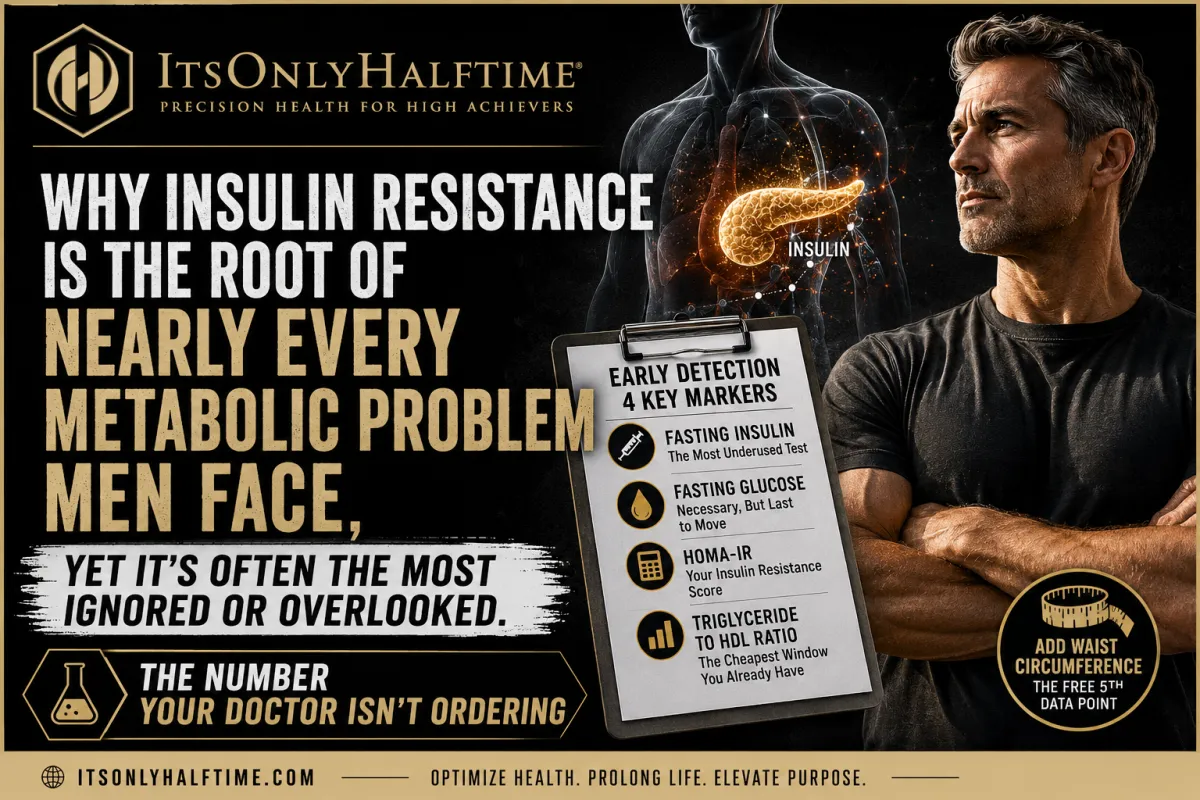
Why Insulin Resistance Is the Root of Nearly Every Metabolic Problem Men Face
THE NUMBERS YOUR DOCTOR LIKELY ISN'T ORDERING
By Dr. Andreas Boettcher, D.C., CFMP, B.S. Health/Exercise Science
3x Ironman Triathlete, Master's Men's Physique Competitor & Medication FREE at 56
Why Insulin Resistance Is the Root of Nearly Every Metabolic Problem Men Face
Most men reading this have had "normal" bloodwork for years. Normal glucose. Normal cholesterol, or close enough. Blood pressure the doctor shrugged at. And yet the belly fat won't move, energy dips at 2 p.m., the libido isn't what it was, and the scale creeps up a pound or two every year no matter what.
Here's the uncomfortable truth: "normal" is measuring the wrong thing, at the wrong time, in the wrong order.
The single most common driver of metabolic dysfunction in men — the thing sitting underneath the high cholesterol, the rising blood pressure, the low testosterone, and the stubborn midsection — is insulin resistance. And by the time it shows up on the tests your doctor routinely orders, it has usually been developing silently for a decade or more.
This article is about how to catch it a decade earlier.
HOW COMMON IS THIS REALLY?
Not a niche problem. The norm.
Only about 12% of American adults are metabolically healthy by strict criteria — meaning roughly 88% have at least one metabolic marker out of optimal range without medication. That study measured health across five factors: blood glucose, triglycerides, HDL, blood pressure, and waist circumference.
Analysis of national survey data (NHANES) found roughly 40% of US adults aged 18 to 44 are insulin-resistant by HOMA-IR — and that's the young cohort.
Hyperinsulinemia (elevated fasting insulin) in nondiabetic US adults climbed from about 28% in 1999 to over 41% by 2018. Insulin resistance over the same window rose from roughly 25% to 38%.
Men, consistently, show higher prevalence than women across these datasets.
Globally, insulin resistance is estimated at around 26 to 27% of adults — and the US runs well above that average.
Put plainly: if you're a man over 35, the base-rate odds that you have some degree of insulin resistance right now are close to a coin flip, and rise steeply from there. Most of the men carrying it have been told their labs look fine.
WHY THE "NORMAL" LABS MISS IT: THE ORDER OF FAILURE
Insulin resistance doesn't announce itself. It progresses in a predictable sequence, and conventional screening watches for the last domino instead of the first.
Here's the actual order of events:
One. Cells start resisting insulin's signal. Nothing shows on standard labs yet.
Two. The pancreas compensates by pumping out more insulin. Fasting insulin rises. Blood glucose stays perfectly normal — because the extra insulin is forcing it to. This is the critical, invisible stage, and it can last 10 to 15 years.
Three. Triglycerides climb and HDL falls. The lipid panel starts drifting before glucose does.
Four. Fasting glucose finally creeps up — 91, 96, 101 — and someone calls it "prediabetes," as if it's breaking news.
Five. HbA1c rises, and now it's "official."
The problem is that steps four and five — glucose and A1c — are the markers almost everyone gets. They're the evidence of what already happened, not an early warning. A man can sit at a fasting glucose of 91 mg/dL and be reassured for twelve straight years while his fasting insulin quietly doubles, his waist expands, and his triglyceride-to-HDL ratio deteriorates.
Glucose is the smoke detector that goes off after the house has been smoldering for a decade.
THE FOUR MARKERS THAT ACTUALLY CATCH IT EARLY
You don't need exotic testing. You need the right common tests, read against optimal ranges instead of the lab's "normal" flags. These four, read together, will surface insulin resistance long before glucose or A1c ever move.
Marker 1: Fasting Insulin — the most underused test in men's health
This is the one your doctor almost certainly isn't ordering, and it's arguably the most important early marker there is. It measures the compensation directly — the extra insulin the pancreas is producing to keep glucose looking normal.
The catch is the gap between "normal" and "optimal." Standard labs flag insulin as high only above roughly 25 uIU/mL. But the outcomes research points to a much tighter functional window:
Under 5 uIU/mL — Optimal, excellent insulin sensitivity
5 to 7 uIU/mL — Good, low risk
7 to 10 uIU/mL — Early insulin resistance possible, watch closely
10 to 15 uIU/mL — Insulin resistance likely present
15 to 25 uIU/mL — Significant resistance (still reads "normal" on most reports)
Over 25 uIU/mL — Severe, full metabolic workup warranted
A note on these ranges: these functional cutoffs are not universally standardized — different clinics use slightly different numbers, and fasting insulin assays vary. That's a real limitation, which is exactly why you don't rely on it alone. But the direction is not controversial: a man at 18 uIU/mL who's been told his labs are "normal" is not metabolically healthy.
Test requirements: 8 to 12 hour fast, ideally drawn before 10 a.m. Often under $20 direct-to-consumer.
Marker 2: Fasting Glucose — necessary, but the last to move
Get it, but understand what it is: a lagging confirmation, not a screen. Optimal fasting glucose sits in roughly the 70 to 85 mg/dL range. "Normal" up to 99 gives the longest false sense of security of any test in the panel. On its own, it's insufficient. Its real value here is as an input into the next number.
Marker 3: HOMA-IR — combining the two into one resistance score
HOMA-IR takes fasting glucose and fasting insulin together to estimate insulin resistance directly:
HOMA-IR equals fasting glucose (mg/dL) times fasting insulin (uIU/mL), divided by 405.
Functional target: under 1.5. Higher values indicate rising resistance. Because it incorporates insulin, HOMA-IR catches dysfunction years before a glucose-only reading would flinch. Its weakness is that it's a single fasting snapshot and inherits the insulin assay's variability — so treat it as one strong signal in a set, not a verdict.
Marker 4: Triglyceride-to-HDL Ratio — the cheapest window you already have
This one is beautiful because nearly every man already has the data sitting in an old lipid panel. Divide triglycerides by HDL (both in mg/dL):
Under 1.5 — Optimal, suggests good insulin sensitivity
1.5 to 3 — Watch
Over 3 — Strongly associated with insulin resistance
Elevated triglycerides and low HDL are among the earliest lipid signatures of insulin resistance — they typically drift before glucose does. In the research, triglycerides, HDL, and waist circumference all track tightly with rising insulin even in people labeled "normal." The ratio turns a routine cholesterol test into an insulin-resistance screen at no extra cost.
Add waist circumference as a free fifth data point — an expanding waist tracks the same underlying process.
THE MOST EFFECTIVE EARLY-DETECTION APPROACH, IN ONE PARAGRAPH
Order fasting insulin and fasting glucose together (which gives you HOMA-IR for free), pull the triglyceride-to-HDL ratio from a standard lipid panel, and measure waist circumference. Read every one of them against optimal ranges, not the lab's "normal" flags. No single number is the answer — you triangulate. If fasting insulin is climbing while glucose still looks fine, that's your decade-early warning, and it's the highest-value thing this whole workup can tell you. If you want to see what fasting numbers can't — the post-meal glucose spikes that drive damage — a short stint with a continuous glucose monitor (CGM) layers real-world variability on top of the fasting picture.
WHY THIS IS THE FOUNDATION OF NEARLY EVERYTHING ELSE
Here's the thesis, and the research supports the shape of it: insulin resistance isn't one metabolic problem among many. It's frequently the upstream driver of the others men come in worried about.
"High cholesterol." The pattern that actually predicts cardiovascular risk in insulin-resistant men — high triglycerides, low HDL, small dense LDL — is driven substantially by insulin resistance, not dietary cholesterol. Treat the resistance and the lipid picture often reorganizes.
High blood pressure. Insulin resistance promotes sodium retention, sympathetic nervous system activation, and vascular stiffening. Hypertension and insulin resistance travel together for mechanistic reasons, not coincidence.
Low testosterone. Hyperinsulinemia and visceral fat suppress testosterone and drive its conversion to estrogen, while low testosterone worsens insulin resistance — a self-reinforcing loop. This is why chasing a testosterone number without addressing the metabolic foundation so often disappoints.
Stubborn belly fat. Visceral fat is both a cause and a consequence of insulin resistance. High insulin is a fat-storage signal; you can't out-train a hormonal environment locked in storage mode.
Energy, focus, the afternoon crash. The glucose swings underneath insulin resistance are felt long before any number is called abnormal.
This is the argument for fixing the foundation first — pro-medicine, in the right order. Optimize the physiology that sits underneath these problems, and a surprising number of the "separate" issues stop being separate. Where genuine exogenous support is still warranted after that, it's built on solid ground instead of papering over the root cause.
The tragedy is that the marker that would catch all of this a decade early costs about twenty dollars and almost nobody orders it.
Ready To Take Charge of Your Health With the Most Comprehensive Natural Approach to Mens Health?
If you'd like to go deeper — to uncover the root causes behind your energy, hormones, metabolism, and performance — I invite you to book a complimentary consultation.
Together, we'll review your health history and goals and determine if our Wealthy Body Protocol based on your lab analysis, genetics, and lifestyle data is right for you!
👉 Click here to apply: limited clients accepted each quarter
To learn more about our Wealthy Body Protocol and success stories visit www.ItsOnlyHalftime.com/wbp, where we help men like you turn your second half into your best half naturally!
Finish Strong,
Dr. Andreas
Still Kickin' A** Medication Free at 56 Despite What the "Narrative" Would Like You To Believe!

Medical Disclaimer:
The information provided in this article is for educational and informational purposes only and is not intended as medical advice. It should not replace professional consultation, diagnosis, or treatment. Always consult your healthcare provider before making any changes to your health regimen or lifestyle.