

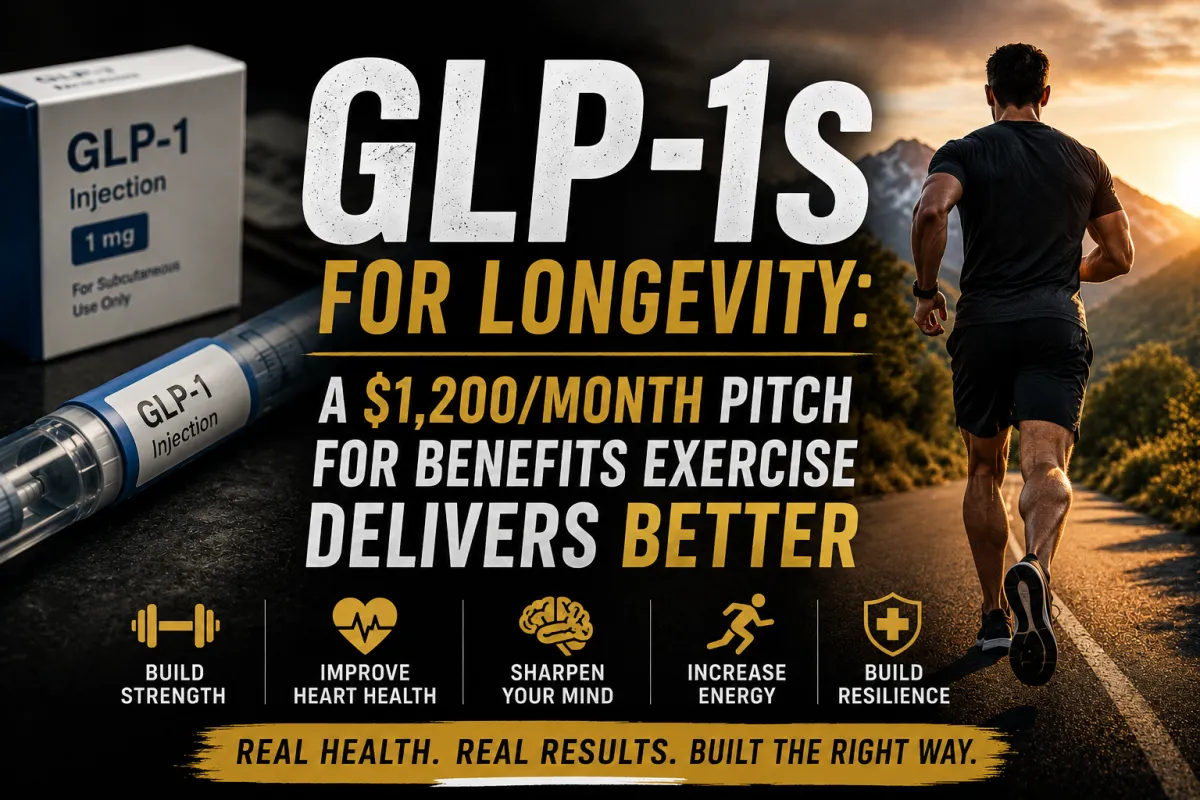
GLP-1s for Longevity: A $1,200/Month Pitch for Benefits Exercise Delivers Better
By Dr. Andreas Boettcher, D.C., Functional Medicine, B.S. Health/Exercise Science
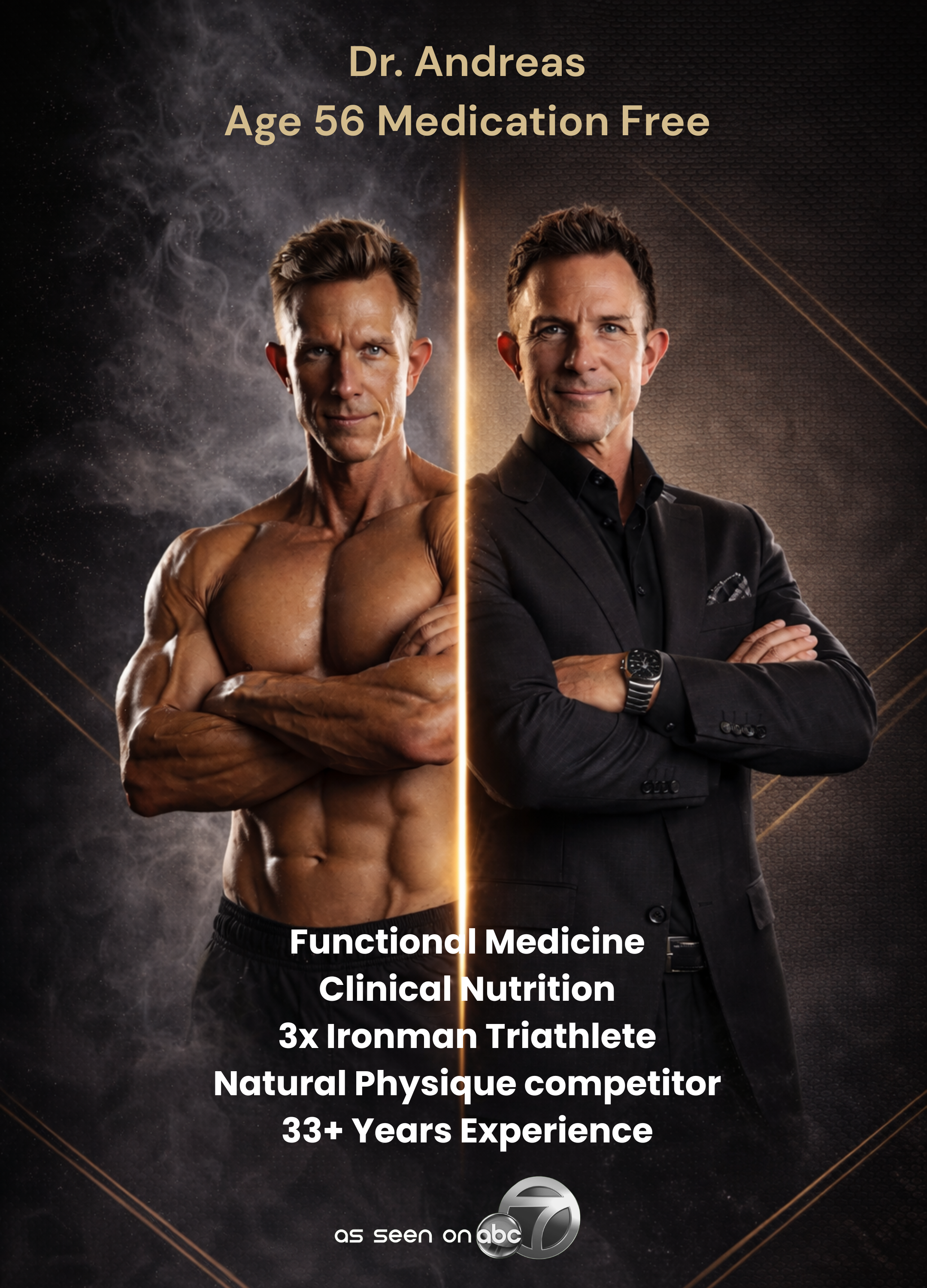
3x Ironman Triathlete, Master's Men's Physique Competitor & Medication FREE at 56
A reel crossed my feed this week. A longevity doctor — Ivy League credentials, calm delivery, the whole package — leaned into the camera and said something that should make every thinking patient pause.
He said he has patients on GLP-1 medications who don't need to lose a single pound.
Not for diabetes. Not for obesity. For longevity. For neuroprotection. For "inflammatory load." For the cardioprotective halo that has accumulated around this drug class over the past five years. He called it frontier medicine. He framed mainstream physicians who don't prescribe this way as behind. He invited the audience to ask their own doctors why they aren't having this conversation.
The reel is well-produced. The mechanism talk is technically defensible at the level of vocabulary. And it is, in my professional opinion, one of the more dangerous pieces of medical content I've seen circulate in recent months.
I want to walk you through why — not because I'm against the responsible use of pharmaceuticals when they're indicated, but because the gap between what the literature actually supports and what these reels imply is now wide enough to drive a malpractice claim through. And because there is a deeper, more important truth being buried by this kind of content: nearly every benefit being claimed for low-dose GLP-1 "longevity protocols" can be achieved more powerfully, more durably, and with vastly less risk through the things your body was designed to do.
Let's break this down honestly.
What the Reel Got Right
I'll start with what is actually true, because I have no interest in straw-manning anyone. GLP-1 receptor agonists — the drug class that includes semaglutide (Ozempic, Wegovy, Rybelsus), liraglutide (Victoza, Saxenda), tirzepatide (Mounjaro, Zepbound), and several others — do far more than suppress appetite.
GLP-1 receptors are expressed across the body. They exist in the brain, the cardiovascular system, the kidneys, the vasculature, and immune cells. That's not controversial.
The two large cardiovascular outcomes trials cited in the reel — LEADER (liraglutide) and SUSTAIN-6 (semaglutide) — are real and showed real signals. LEADER demonstrated a 13% reduction in major adverse cardiovascular events over roughly 3.8 years. SUSTAIN-6 showed a 26% reduction over approximately 2 years. The benefit curves separated earlier than weight loss alone could fully explain, which has prompted legitimate research into weight-independent mechanisms: anti-inflammatory signaling in arterial tissue, reductions in oxidative stress, and improved endothelial function.
This is interesting science. It is being studied. It has earned its place in cardiology conversations for the specific high-risk diabetic populations these trials enrolled.
That is where the truthful skeleton ends. Now let's talk about where the reel stretches the science past anything the literature will defensibly bear.
The Population Problem
The single most important fact about LEADER, SUSTAIN-6, and the other cardiovascular outcomes trials in the GLP-1 class is this: they were not conducted in healthy adults seeking longevity optimization. They were conducted in patients with type 2 diabetes and established cardiovascular disease or very high cardiovascular risk.
That distinction matters more than almost anything else.
When you take a drug that produces a 13% mortality reduction in a population whose ten-year cardiovascular risk is, say, 25%, you are taking a population that would have had 2,500 deaths per 10,000 down to roughly 2,175 deaths per 10,000. That is a real and clinically meaningful absolute risk reduction.
When you take the same drug and apply it to a metabolically healthy 50-year-old man with a normal A1c, a clean lipid panel, optimal blood pressure, and a high VO2 max, his baseline cardiovascular risk is dramatically lower. A 13% relative risk reduction applied to a small absolute risk produces a vanishingly small absolute benefit — while the side effect profile remains intact.
This is basic pharmacoepidemiology. It is the difference between treating a sick population and medicalizing a healthy one. The reel does not make this distinction. It applies trial data from sick patients to healthy patients as if the benefit transfers cleanly. It doesn't, and any clinician with rigorous training in evidence-based medicine knows it.
"Too Fast to Be Explained by Weight Loss" — A Closer Look
The reel claims the cardiovascular mortality reduction in LEADER and SUSTAIN-6 was "too fast to be explained by weight loss." This framing is doing a lot of work, and most viewers won't catch what's happening.
The benefit curves in LEADER separated around 12 to 18 months. That is plenty of time for weight loss, glycemic improvement, blood pressure reduction, and lipid changes to begin driving outcomes. Researchers in the field debate the relative contribution of weight-independent mechanisms versus weight-dependent ones. They do not conclude — as the reel implies — that the benefit is primarily weight-independent.
This is an unsettled mechanistic question being presented as settled fact in order to justify off-label use in patients who are not losing weight. It's a rhetorical move, not a scientific conclusion.
The Neuroprotection Pitch Just Failed Its Phase 3 Trial
Here's the part of the reel that has aged the worst.
The reel invokes "emerging evidence on GLP-1 and neuroinflammation, Parkinson's disease, and metabolic protection in the brain." It implies that the receptor distribution in the central nervous system is opening a frontier we are only beginning to map.
In November 2025, Novo Nordisk announced the topline results of the EVOKE and EVOKE+ Phase 3 clinical trials — two of the largest GLP-1 trials ever conducted in early Alzheimer's disease, enrolling a combined 3,808 adults aged 55 to 85 with mild cognitive impairment or mild dementia.
The trials failed.
Oral semaglutide did not demonstrate a statistically significant reduction in Alzheimer's disease progression compared to placebo, as measured by the Clinical Dementia Rating – Sum of Boxes scale. Novo Nordisk announced it would discontinue the one-year extension period of both trials based on the efficacy results. The Alzheimer's Association issued a public statement expressing disappointment.
The biomarker signals improved. The clinical endpoint — the thing that actually matters to a patient and their family — did not.
This is what "emerging evidence" looks like when it actually gets tested in a Phase 3 trial. Sometimes the mechanism is real and the clinical benefit doesn't materialize. That is exactly the gap that distinguishes preliminary signal from established therapy, and it is exactly the gap that influencer physicians paper over when they pitch off-label prescribing to healthy patients.
The Parkinson's data is similarly mixed. The earlier Exenatide-PD2 trial showed some signal. The more recent Lixisenatide LIXIPARK trial in 2024 showed modest motor signals but with tolerability concerns. Neither of these supports prescribing GLP-1 medications to healthy patients without Parkinson's disease for "neuroprotection." That is several leagues beyond what the data justifies.
"Different Dose, Different Goal, Different Monitoring Protocol"
The reel closes with the framing that low-dose GLP-1 longevity protocols use different dosing, different goals, and different monitoring than the standard indications.
Here is what is missing from that framing: there is no validated low-dose GLP-1 longevity protocol in the peer-reviewed literature.
There is no published dose-response data establishing the anti-inflammatory benefit threshold in healthy adults. There is no consensus monitoring standard. There is no longitudinal safety data in the population being targeted — metabolically healthy adults using these drugs for non-indicated purposes over years. The phrase "frontier medicine being practiced by physicians who are reading the mechanism in the literature" is doing the heaviest lifting in the entire reel. It sounds sophisticated. What it actually means, functionally, is: "I am prescribing a drug class outside its evidence base based on personal interpretation, and you should trust me."
That is not a defensible position when something goes wrong. And things are going wrong.
The Litigation Landscape He Didn't Mention
This is where the reel becomes something more than rhetorical overreach. This is where it becomes, in my view, professionally irresponsible.
As of May 2026, the multidistrict litigation against the manufacturers of GLP-1 medications has grown to a scale that should make any prescribing physician, and any patient, pay attention.
MDL 3094 — the consolidated federal litigation handling gastrointestinal injury claims against Novo Nordisk (Ozempic, Wegovy, Rybelsus) and Eli Lilly (Mounjaro, Trulicity, Zepbound) — now contains over 3,636 pending cases. The presiding judge is Karen Spencer Marston in the Eastern District of Pennsylvania. The most frequently listed injuries in those complaints, according to a court breakdown given in a January 2026 hearing, are:
Gastroparesis (stomach paralysis) — listed in 75% of complaints
Ileus (impaired bowel function) — 18%
Gallbladder complications — 8%
Other severe gastrointestinal conditions, including intestinal obstruction — 8%
A separate MDL — MDL 3163 — handles claims related to non-arteritic anterior ischemic optic neuropathy (NAION), the form of sudden vision loss linked to semaglutide in a 2024 JAMA Ophthalmology study that identified a fourfold elevated risk in semaglutide users with type 2 diabetes. As of May 2026, MDL 3163 contains 86 pending cases and is growing.
Additional state-level multicounty litigations are pending in New Jersey, where Novo Nordisk maintains its U.S. headquarters.
This is not a hypothetical risk profile. This is one of the largest pharmaceutical mass torts of the decade, currently active, with bellwether trials approaching. The FDA added an intestinal obstruction warning to the Ozempic label in 2023. Plaintiffs allege the warning came too late and remains inadequate.
The reel mentioned none of this.
It pitched the drug class for healthy patients who don't need it, framed mainstream caution as ignorance, and omitted the fact that the on-label use in the actually-sick population is the subject of thousands of failure-to-warn lawsuits. From a medico-legal standpoint, that is a striking position to broadcast publicly.
If you are an executive considering an off-label GLP-1 longevity protocol because of a reel like this, you should know what you would actually be signing up for: a medication with an active mass-tort docket, no validated longevity protocol, no published low-dose efficacy threshold, and a risk profile that includes gastroparesis, ileus, intestinal obstruction, gallbladder disease, NAION, pancreatitis, thyroid C-cell tumor concerns, and meaningful lean mass loss in many users.
For an executive in his fifties whose actual longevity threat is sarcopenia, not cardiovascular disease, the lean mass loss alone should give pause. GLP-1 weight loss studies have consistently shown that approximately 40% of the weight lost is lean tissue. For a 55-year-old man, lean tissue is the substrate of independence in the third half of life. Trading it for a marginal anti-inflammatory benefit you could achieve through exercise is one of the worst deals in modern medicine.
What the Same Patient Can Get for Free — and Why It's a Better Deal
This is the part the reel deliberately doesn't engage with, because if it did, the entire pitch collapses. Every mechanism being claimed for low-dose GLP-1 longevity protocols has a lifestyle intervention with equal or superior evidence, zero litigation exposure, and broader systemic benefit.
Let me walk you through each one.
Endothelial Function and Arterial Health
Zone 2 cardio — performed three to four times per week at conversational pace for 45 to 60 minutes — improves endothelial nitric oxide production, mitochondrial density, flow-mediated dilation, and arterial compliance. The evidence base here is decades deep and far more robust than anything in the GLP-1 longevity literature.
Resistance training, performed three to four times per week, independently improves arterial compliance and reduces all-cause mortality. The combined effect of structured aerobic and resistance training on endothelial function rivals or exceeds anything a GLP-1 medication produces — without the risk of gastroparesis or vision loss.
Anti-Inflammatory Signaling and Oxidative Stress
The reel emphasizes anti-inflammatory mechanisms. Here are the levers with better data and zero side effects:
A whole-food, lower-glycemic, nutrient-dense diet — what I structure for my clients individually based on their lab work and genetics — reduces hsCRP, IL-6, and TNF-alpha. Time-restricted eating, properly implemented, reduces systemic inflammation independent of weight loss. Omega-3 status optimization, measured by omega-3 index (target above 8%), reduces inflammatory cytokine production. Sleep architecture optimization is the single biggest unrecognized lever on systemic inflammation in executive populations and most patients ignore it entirely.
In my own practice, I address inflammatory load at its actual source through gut testing (GI-MAP), genetic analysis, and individualized protocols built from 415+ biomarkers. That is not theoretical. That is what I do every week with executives whose chronic inflammation is being driven by mechanisms a GLP-1 medication does not touch.
Cardiovascular Mortality Reduction
This one matters. A 2018 JAMA Network Open study by Mandsager and colleagues, analyzing over 122,000 patients, demonstrated that cardiorespiratory fitness in the top quartile is associated with a hazard ratio for all-cause mortality of roughly 0.20 compared to the bottom quartile. That is a five-fold reduction in mortality risk.
No cardiology drug in the world comes close to that effect size. The 13% relative risk reduction observed in LEADER, in a high-risk diabetic population, is dwarfed by what cardiorespiratory fitness delivers across the general population.
If a physician wants to talk about longevity medicine, the conversation begins and ends with VO2 max. Pharmacology is a distant second.
Neuroprotection
Aerobic exercise increases brain-derived neurotrophic factor (BDNF), improves hippocampal volume, and has the strongest evidence base of any intervention for cognitive aging. Resistance training is independently neuroprotective. Metabolic flexibility — the ability to switch efficiently between fuel sources — protects against insulin resistance in the brain, which is the actual upstream mechanism in Alzheimer's pathology.
The EVOKE trials failed because semaglutide could not deliver clinical neuroprotection. Exercise, by contrast, has decades of consistent data on cognitive aging.
Weight and Body Composition
For an executive in his fifties or sixties, the goal is not weight loss. The goal is body composition: maximum lean mass, minimum visceral fat, preserved bone density. Lifestyle interventions properly structured produce durable composition change that protects against sarcopenia. GLP-1 medications, in many studies, accelerate the very loss of lean tissue that drives functional decline in the third half of life.
This is not a small consideration. It is potentially the most important consideration. The men who lose their independence at 75 don't lose it because of cholesterol. They lose it because they can't get up off the floor.
What I Actually Believe About GLP-1 Medications
I want to be clear about my position, because reasonable people can disagree on this without anyone being a zealot.
For patients with type 2 diabetes who have failed lifestyle intervention and need glycemic control, GLP-1 medications are a legitimate option with real benefit. For patients with severe obesity who have failed structured lifestyle intervention and whose health is meaningfully threatened by their weight, GLP-1 medications are a legitimate option with real benefit. The cardiovascular outcomes data in those populations is real.
What I object to is the medicalization of healthy adults under the banner of "longevity medicine." I object to the framing of mainstream caution as ignorance. I object to the omission of an active mass-tort litigation landscape. I object to the use of "emerging evidence" as a wrapper for "we are prescribing this without published protocols." And I object, most of all, to the suggestion that frontier pharmacology has anything to teach us about longevity that exercise, nutrition, sleep, and metabolic flexibility haven't already proven over decades.
The men I work with don't need to be on a drug class with thousands of lawsuits attached to it. They need to train properly, eat for their genetics and gut, sleep enough, lift heavy enough, run hard enough, and let their bodies do what bodies do when you actually take care of them.
I am 56 years old. Medication-free. Single-digit body fat. I am not telling you this to brag. I am telling you because I built this body and this clinical practice while running an international speaking career, blending and raising a family, recovering from emergency back surgery, reversing an autoimmune condition, and pulling my own testosterone back from a crash to 216 ng/dL without exogenous hormones. I have been there. I have done that. And I built none of it on a GLP-1 medication.
If a physician is telling you that a drug with an active multidistrict litigation is the frontier of longevity medicine, the frontier you are actually being sold is the inside of his prescription pad. The mechanism talk is the wrapper. The pitch is the access.
The Bigger Pattern
Here's what I want every executive reading this to internalize, because this is not the last time you will see this play run.
Every time a new drug class with a large mechanism story enters the market, this exact reel will appear. The actor will change. The credentials will be impressive. The vocabulary will be sophisticated. The hook will be some version of "your doctor isn't telling you this." The omission will always be the same: the real risk profile, the limits of the data, and the catastrophic asymmetry between what the drug can do and what fundamentals can do for free.
This was the pattern with testosterone clinics, with stem cell IVs, with NAD+ infusions, with peptide therapy, with chelation therapy, with hyperbaric oxygen for non-indicated uses. None of those are universally bad. Some of them have niche legitimate applications. All of them have been over-marketed by influencer physicians whose business model is prescription-pad access disguised as cutting-edge science.
Frontier medicine, the way it is actually practiced by people who know what they are doing, looks boring from the outside. It looks like comprehensive lab work. It looks like genetic analysis. It looks like gut testing and methylation pathways and lipid subfractions. It looks like an individualized nutrition plan and a periodized training program and a sleep protocol and stress management practice. It looks like consistent execution over decades.
It does not look like a reel.
The reel is not the frontier. The reel is the marketing department.
Final Word
If a GLP-1 medication is appropriate for you because of your actual medical picture, take it with informed consent and proper monitoring. That is between you and a physician who knows your case in depth.
If a longevity influencer is pitching you a low-dose protocol for benefits you could achieve through exercise, nutrition, and sleep, recognize what you're being sold. The drug class is in active mass-tort litigation. The Alzheimer's neuroprotection thesis just failed its Phase 3 trial. The longevity protocols are unpublished. And the benefits being promised are dwarfed, in nearly every category, by what your body will deliver for free when you actually train it.
Halftime is the moment you stop accepting the easy story and start asking the hard question.
The hard question is not "why isn't my doctor having this conversation."
The hard question is whether the conversation you're being invited into is medicine — or marketing dressed up in a white coat.
⚡️ Ready To Take Charge of Your Health With the Most Comprehensive Natural Approach to Mens Health?
If you'd like to go deeper — to uncover the root causes behind your energy, hormones, metabolism, and performance — I invite you to book a complimentary consultation.
Together, we'll review your health history and goals and determine if our Wealthy Body Protocol based on your lab analysis, genetics, and lifestyle data is right for you!
👉Click here to apply: limited clients accepted each quarter
To learn more about our approach and success stories, visitwww.ItsOnlyHalftime.com, where we help men like you turn your second half into your best half naturally!
Finish Strong,
Dr. Andreas
Still Kickin' A** Medication Free at 56 Despite What the "Narrative" Would Like You To Believe!
Medical Disclaimer:
The information provided in this article is for educational and informational purposes only and is not intended as medical advice. It should not replace professional consultation, diagnosis, or treatment. Always consult your healthcare provider before making any changes to your health regimen or lifestyle.