

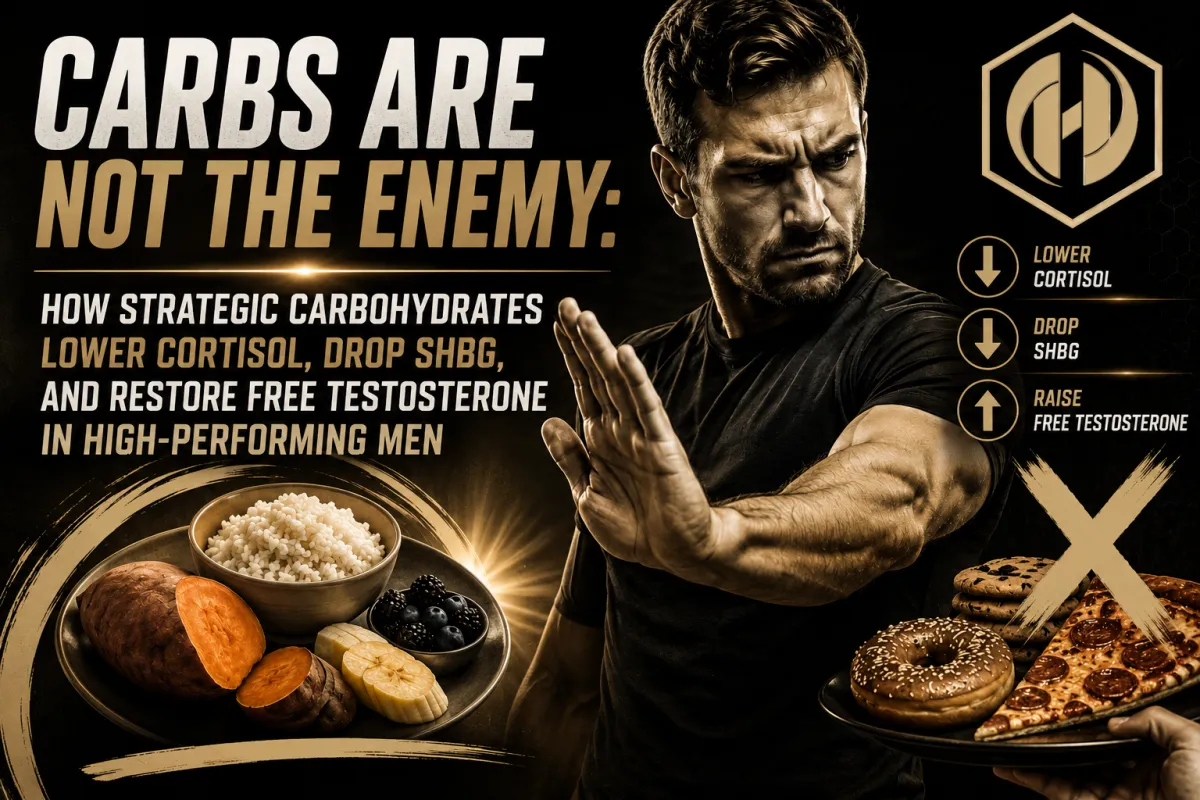
Carbs Are Not the Enemy: How Strategic Carbohydrates Lower Cortisol, Drop SHBG, and Restore Free Testosterone in High-Performing Men
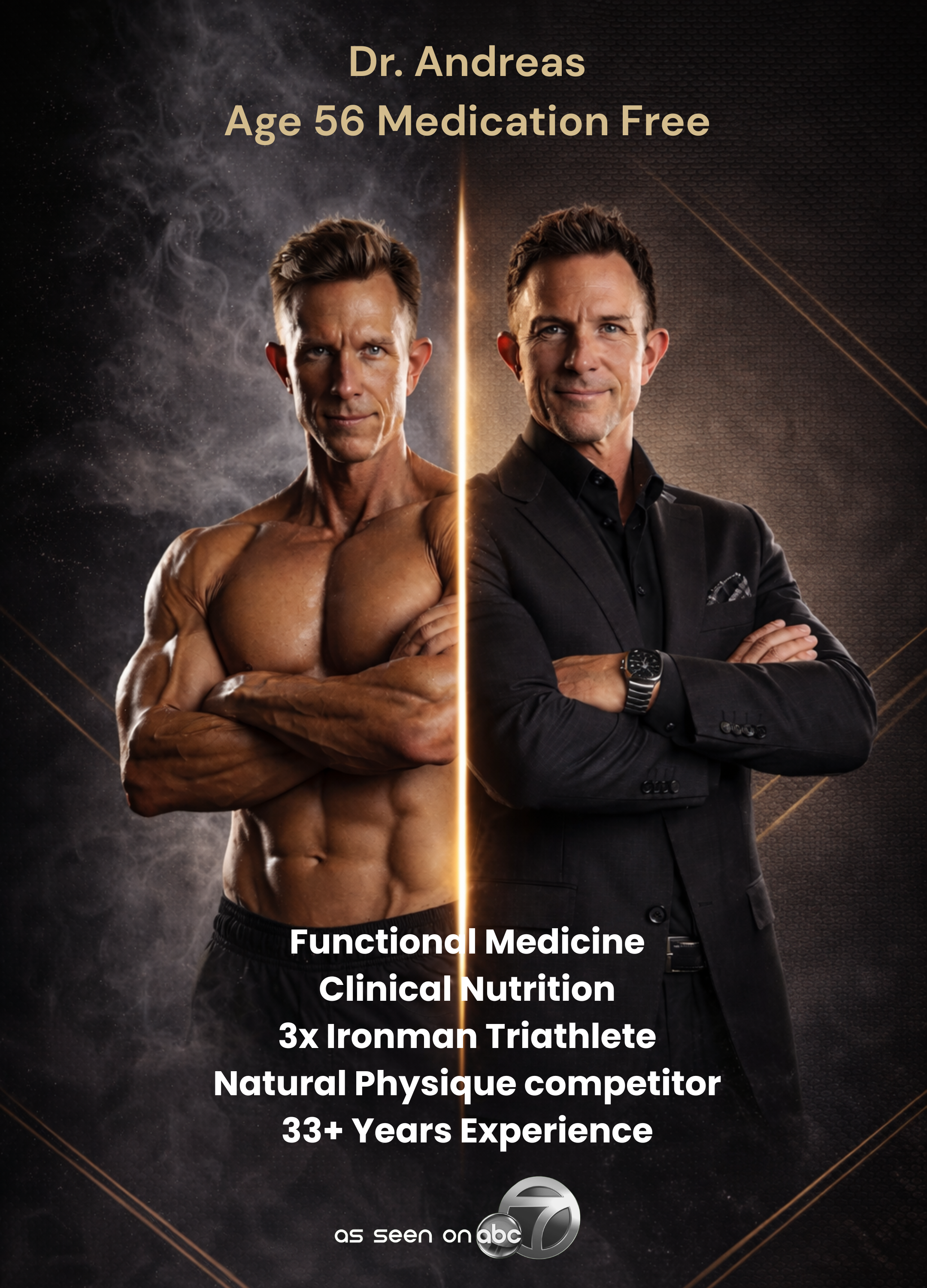
By Dr. Andreas Boettcher, D.C., Functional Medicine, B.S. Health/Exercise Science
3x Ironman Triathlete, Master's Men's Physique Competitor & Medication FREE at 56
The Most Misunderstood Macronutrient in Men's Health
Somewhere along the way, carbohydrates became the villain of the high-performing man's story.
Bread became poison. Fruit became sugar. Rice became weakness. And evening carbs? Practically a moral failing — a quiet betrayal of the discipline you'd worked so hard to build.
I understand how we got here. The cultural overcorrection away from processed-food gluttony was not just necessary — it was overdue. For two decades, low-carb, ketogenic, and carnivore approaches have rescued countless men from metabolic disaster. I've seen it firsthand in my own clinical practice. I've lived it personally. And I still recommend low-carb and ketogenic-style frameworks for the right man at the right time.
But somewhere between "processed carbohydrates are destroying you" and "all carbohydrates are the enemy," a critical piece of physiology got buried.
Strategic carbohydrate intake — at the right amount, the right time, and in the right metabolic context — can absolutely influence cortisol regulation, SHBG, free testosterone, thyroid conversion, and sleep architecture in ways that supplements, training, and willpower cannot replicate.
Carbohydrates are not a sin. They are a tool.
And like every tool, they are useless in the wrong hands and transformative in the right ones.
This is the article I wish every executive, surgeon, founder, and top-producing wealth advisor I work with had read three years before they sat across from me wondering why their labs looked "perfect" but their body felt broken.
Let's break it down the way I break it down in the clinic.
The First Distinction That Changes Everything
Before we go a single layer deeper, you need to internalize this: Not all carbohydrates are equal. Not all men need the same amount. And timing matters more than dose.
A metabolically broken, insulin-resistant man abusing donuts, pasta, and Diet Coke is living in a fundamentally different physiological universe than a lean, active, insulin-sensitive man strategically using sweet potatoes and seasonal fruit as a hormonal lever.
These two men cannot — and should not — be advised by the same blanket rule.
Most popular nutrition advice fails because it tries to give one prescription to two completely different patients. The internet tells the metabolically broken man and the metabolically optimized man to do the exact same thing. That is malpractice in slow motion.
In our world — the world of high performers, executive athletes, and men chasing precision instead of mediocrity — generic advice is the enemy. Personalization is the standard.
So let's get into the physiology.
Cortisol: The Survival Hormone You're Probably Underestimating
Cortisol is not the enemy either. Cortisol is fundamentally a survival hormone. Its job is straightforward and ancient: maintain blood sugar, mobilize fuel, and keep you alive during stress, fasting, sleep deprivation, overtraining, or caloric restriction.
When glucose availability is chronically low — especially in highly driven men who overtrain, under-eat, fast aggressively, live under chronic sympathetic load, travel constantly, sleep poorly, or stay excessively low-carb for too long — the body does what it has done for hundreds of thousands of years.
It compensates by increasing cortisol output to maintain blood glucose through gluconeogenesis.
In simple terms: your body starts manufacturing glucose from stress hormones.
Read that again. Because this is the silent mechanism that breaks more high performers than any single nutritional mistake I see in the clinic.
This is why some men on long-term ultra-low-carb approaches — men who started with extraordinary results — eventually begin to unravel in ways they cannot explain. Their sleep fractures, particularly between two and four in the morning. Their nighttime cortisol climbs on a DUTCH or salivary panel. Their total and free testosterone flatten. SHBG rises. The conversion of T4 to T3 — the active thyroid hormone that runs your entire metabolic engine — begins to stall. Recovery from training slows to a crawl. Libido quietly disappears. And that stubborn layer of abdominal fat? It refuses to budge despite discipline that would put most men to shame.
These men aren't failing their diet. Their diet is failing them.
The protocol that fixed the first version of them is now breaking the second version of them. This is one of the most common patterns I diagnose in executives who are doing "everything right" and still feel like the wheels are loosening.
How Strategic Evening Carbohydrates Lower Cortisol
Here is where most men reflexively flinch. Evening carbohydrates? Isn't that the cardinal sin?
Not in the metabolically optimized man. Quite the opposite.
Properly timed evening carbohydrates can actively reduce cortisol through several elegant physiological mechanisms — and once you understand them, you'll wonder why no one explained this to you sooner.
The Serotonin-Melatonin Cascade
The right carbohydrates produce a modest, controlled rise in insulin. That insulin shuttles competing branched-chain amino acids into muscle tissue, which allows tryptophan a clearer path across the blood-brain barrier. Tryptophan becomes serotonin. Serotonin becomes melatonin. And the downstream cascade is profound: parasympathetic tone improves, the nervous system quiets, sleep onset accelerates, nocturnal cortisol spikes diminish, and both deep and REM sleep deepen measurably.
This is precisely why so many of my high-performing clients sleep dramatically better — measurably better on their WHOOP, Oura, or Garmin data — when we add a properly timed carbohydrate dose to dinner. The data is not subtle. It often shows up within seven to ten days.
Quieting the Nighttime Alarm System
When liver glycogen is excessively depleted overnight, the body has only one option to maintain blood sugar: elevate cortisol and adrenaline during sleep. This is the mechanism behind that maddening pattern of waking at two, three, or four in the morning with a racing heart and an anxious mind — not because something woke you, but because your own stress hormones dragged you out of deep sleep to deal with a fuel crisis. It's that "wired but tired" feeling at midnight, that inability to stay asleep even when falling asleep was easy. Your body is running an emergency glucose protocol while you're trying to rest.
Strategic evening carbohydrates replenish liver glycogen just enough to keep the body out of crisis mode. The result is a quieter nervous system from two in the morning until your alarm goes off. For men who have spent years wondering why their sleep tracker looks like a war zone, this single adjustment is often the unlock.
Restoring Thyroid Conversion
Chronically insufficient carbohydrate intake impairs the conversion of T4 to T3 — the active thyroid hormone that runs your metabolism. When T3 drops, the consequences compound in every direction: cortisol rises to compensate, metabolic rate slows, recovery deteriorates, SHBG creeps upward, extremities run cold, morning resting heart rate drops below where it should be, and a persistent mental sluggishness settles in — the kind that persists despite doing "everything right."
Adequate carbohydrate intake — especially in active, lean men — supports thyroid physiology directly, which indirectly normalizes cortisol output and restores hormonal momentum across the entire endocrine system. This is not a minor detail. It is a foundational lever.
SHBG: The Liver Protein That Quietly Decides How Much Testosterone You Actually Get to Use
Here is where the conversation gets sophisticated, and where most "men's health" content stops short.
Sex Hormone Binding Globulin — SHBG — is a liver protein that binds to testosterone in the bloodstream. The testosterone that is bound to SHBG is biologically inactive. Your tissues cannot use it. Your brain cannot use it. Your libido cannot use it. Your muscles cannot use it.
Only free testosterone — the unbound fraction — actually does the work.
SHBG is heavily influenced by insulin signaling, liver function, thyroid status, caloric intake, inflammation, and your overall metabolic state. And here is the key principle most men have never been taught: higher insulin signaling tends to lower SHBG, while very low insulin states tend to raise it.
This is why some extremely lean, highly disciplined, low-carb men develop a paradoxical pattern on their labs that confuses nearly every physician who sees it. Their total testosterone looks fine — sometimes even excellent. But SHBG is elevated, often dramatically, and free testosterone is suppressed as a result. Libido is in the basement. Recovery is poor. Morning erections are gone. Energy is flat. And every doctor they see tells them the same useless thing: "Your testosterone looks great."
That man does not have a testosterone problem on paper. But he has a testosterone problem in his life.
His liver is producing too much SHBG because his insulin signaling has been suppressed for too long. And this is one of the most common and most missed presentations in lean, disciplined, high-achieving men in their 40s, 50s, and 60s. I see it constantly in the Wealthy Body Protocol intake lab work.
The Critical Caveat: This Is Not Permission to Eat Like a Frat Boy
Let me be unambiguously clear, because this is where men love to misinterpret nuance as permission.
This does not mean eat junk food and spike insulin.
We are talking about strategic insulin signaling — not chronic hyperinsulinemia. And the distinction between those two is the distance between optimization and self-destruction.
There is a massive, non-negotiable difference between insulin resistance driven by processed foods, seed oils, fructose-laden beverages, and metabolic dysfunction — and the physiologic insulin release from strategically timed whole-food carbohydrates in an active, insulin-sensitive man. The first man is dying slowly. The second man is optimizing. These two states look superficially similar in a one-line summary — "he ate carbs" — and are diametrically opposed in their physiological consequences.
Confusing them is the reason men on Reddit argue past each other for ten thousand comments and never actually converge on the truth.
When Strategic Evening Carbohydrates Are Most Powerful
In my clinical experience, evening carbohydrates become particularly transformative for a specific profile of man — and chances are, if you've read this far, you recognize yourself in the description.
He is the man with elevated SHBG on his labs who trains intensely four or more times per week and stays highly active throughout the day. He lives under chronic professional or emotional stress. He wakes repeatedly during the night. His adrenal panel shows dysregulation. His free testosterone is low despite a normal total testosterone number. He carries very low body fat. He has been low-carb or carnivore for two or more years. And he is showing the unmistakable signs of metabolic adaptation — flat energy, dropping morning temperatures, declining libido, and recovery that no longer matches his effort.
That man is not lazy. He is not broken. He is physiologically overtaxed by a strategy that has outlived its usefulness.
The protocol becomes even more effective when paired with sufficient protein at every meal — typically 0.8 to 1.2 grams per pound of lean mass — along with adequate magnesium (particularly glycinate or threonate at night), proper sodium and potassium balance, consistent resistance training, and a genuine commitment to sleep as a non-negotiable performance tool rather than a luxury to be negotiated away.
As for which carbohydrates, the list is not exotic. Sweet potatoes. Squash and root vegetables. White rice — yes, white, not brown, for reasons we can cover another day. Seasonal fruit grown locally when possible. Raw honey, used strategically. These are whole, real foods that your body recognizes and processes efficiently.
The right amount depends entirely on body composition, activity level, insulin sensitivity, stress load, sleep quality, thyroid status, age, training volume, and goals. There is no universal number. The man telling you there is, is selling you something.
The Biggest Mistake I See in High-Performing Men
The single most common mistake I see in disciplined men is this: They confuse "low-carb worked initially" with "lower-carb forever is optimal."
Most men feel extraordinary in the first six to eighteen months of a ketogenic or carnivore approach. And there are excellent physiological reasons for that. Inflammation drops sharply. Processed foods and seed oils disappear from the picture. Blood sugar stabilizes. Appetite normalizes. Mental clarity improves. They finally stop abusing their metabolism. This phase is real. It is valuable. And for many men it is genuinely transformative.
But over time — particularly in already-driven, sympathetically dominant men with high cognitive load — the cumulative stress signal begins to accumulate. The same protocol that rescued them in year one can quietly tax them in year three.
This is especially true in executives, surgeons, founders, and top-producing professionals who are already running with their nervous system in fifth gear from the moment they wake up. Their physiology has no margin to absorb additional metabolic stress on top of professional and life pressure.
At that point, strategic carbohydrate reintroduction often produces results that feel almost too good to be true. Sleep architecture deepens. Cortisol normalizes — particularly the nighttime cortisol that had been silently sabotaging recovery. T4-to-T3 thyroid conversion restores. SHBG comes down. Free testosterone rises. Training recovery accelerates. Libido and morning erections return. And that energy and edge they had in their first year of low-carb? It comes back — often stronger, because now they are fueling a more metabolically mature and resilient system.
The answer is not high-carb. The answer is not low-carb either. The answer is metabolic flexibility and precision.
That distinction — flexibility and precision over dogma — is the single most important upgrade in the modern men's health conversation.
The Wealthy Body Principle
Every man I work with eventually arrives at the same realization.
The body is not a moral document. It is a precision instrument. It does not respond to discipline alone — it responds to informed discipline.
Discipline without data is just stubbornness.
The man who eats zero carbs for five years because a podcast told him to is not optimizing. He is following orders. The man who measures his SHBG, his free testosterone, his fasting insulin, his cortisol rhythm, his thyroid panel, his glucose response, and his sleep architecture — and then adjusts his carbohydrate intake accordingly — is operating at a fundamentally different level.
This is the difference between being motivated and being measured.
This is the difference between training hard and training right.
This is the difference between a body that looks good in a t-shirt and a body that performs at 56 the way most men cannot perform at 36.
The Wealthy Body Protocol exists for the man who is finally ready to stop guessing.
⚡️ Ready To Take Charge of Your Health With the Most Comprehensive Natural Approach to Mens Health?
If you'd like to go deeper — to uncover the root causes behind your energy, hormones, metabolism, and performance — I invite you to book a complimentary consultation.
Together, we'll review your health history and goals and determine if our Wealthy Body Protocol based on yourlab analysis, genetics, and lifestyle data is right for you!
👉Click here to apply: limited clients accepted each quarter
To learn more about our approach and success stories, visit www.ItsOnlyHalftime.com, where we help men like you turn your second half into your best half naturally!
Finish Strong,
Dr. Andreas
Still Kickin' A** Medication Free at 56 Despite What the "Narrative" Would Like You To Believe!
Medical Disclaimer:
The information provided in this article is for educational and informational purposes only and is not intended as medical advice. It should not replace professional consultation, diagnosis, or treatment. Always consult your healthcare provider before making any changes to your health regimen or lifestyle.