

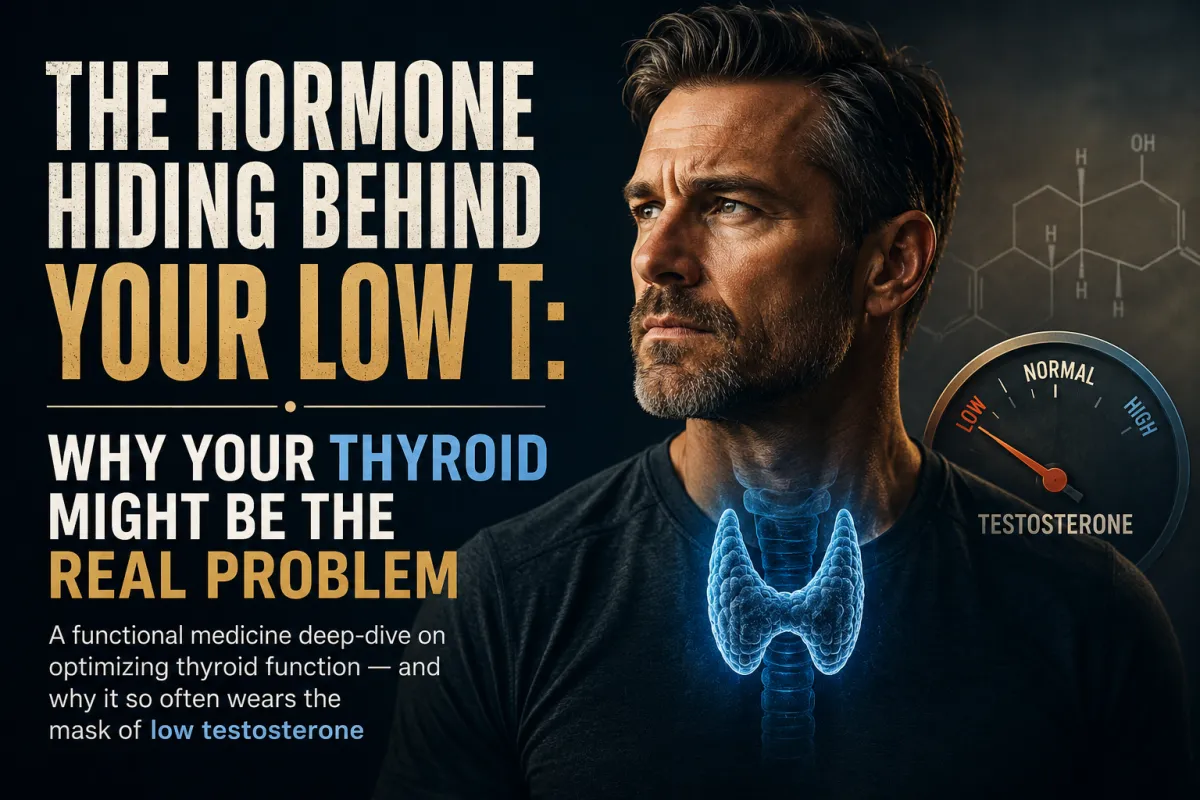
The Hormone Hiding Behind Your Low T: Why Your Thyroid Might Be the Real Problem
A functional medicine deep-dive on optimizing thyroid function — and why it so often wears the mask of low testosterone
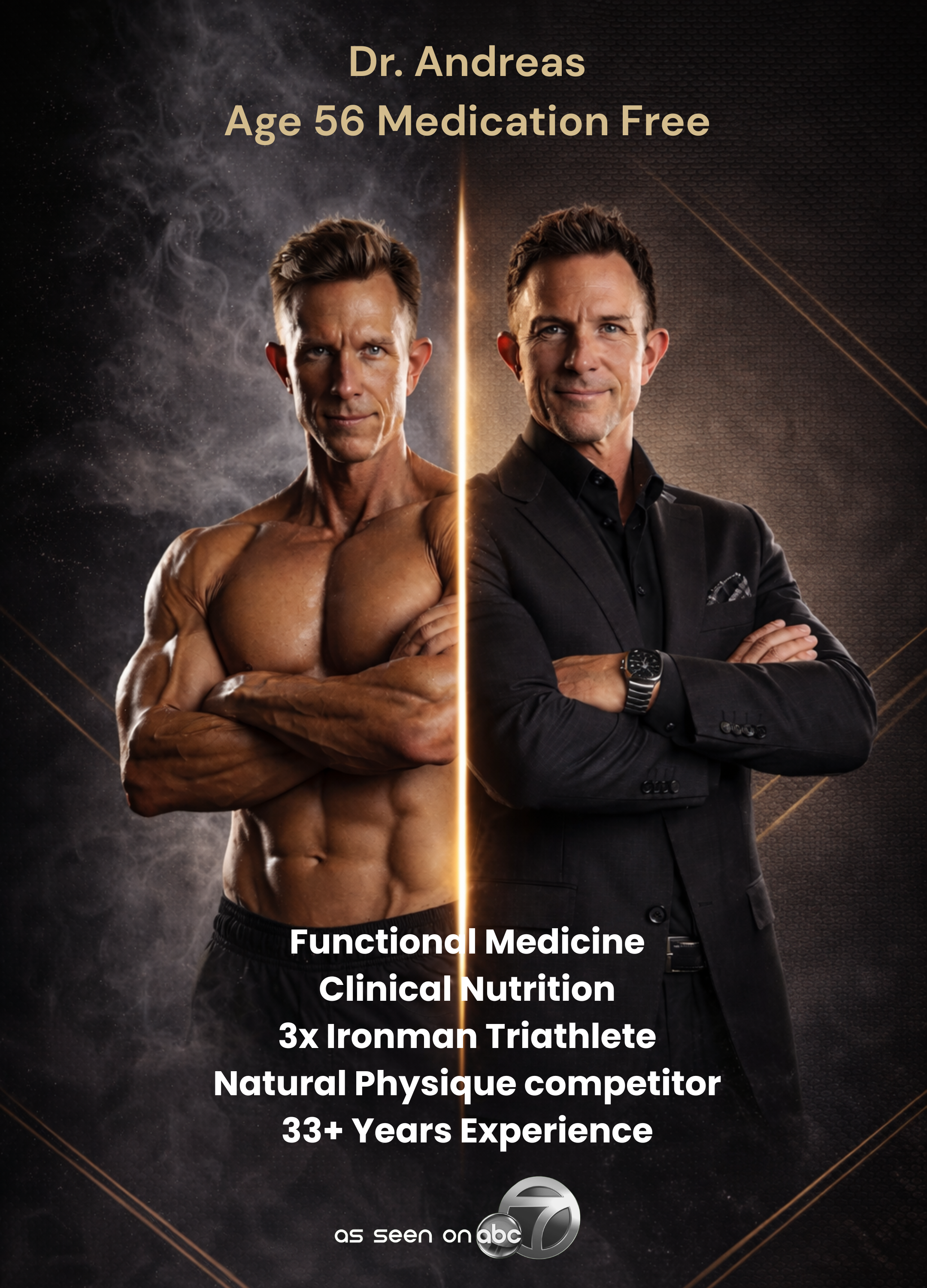
By Dr. Andreas Boettcher, D.C., Functional Medicine, B.S. Health/Exercise Science
3x Ironman Triathlete, Master's Men's Physique Competitor & Medication FREE at 56
You feel it before any lab confirms it.
The energy that used to be automatic now has to be manufactured. The drive that built your career, your body, your reputation — it flickers. Workouts that once lit you up now leave you flat. The weight creeps on in places it never used to. Your libido isn't what it was. Your focus fractures. And somewhere in the back of your mind, a single word starts repeating: testosterone.
For a high-achieving man in the second half of life, that's a reasonable first guess. Testosterone is the headline hormone, and a real decline is common. But here's what most men — and frankly, most clinics — get wrong: the exact symptom picture of low testosterone is also the exact symptom picture of low thyroid function. Fatigue, depression, anxiety, low libido, poor sexual performance, stubborn weight gain, brain fog, and a body that fights you in the gym.
Draw a Venn diagram of low-T symptoms and low-thyroid symptoms, and you don't get two overlapping circles. You get one circle. They converge almost completely.
This is the single most expensive blind spot in men's health optimization. Because if a man walks into a clinic, gets handed a testosterone prescription, and his real problem was a struggling thyroid, he doesn't get better. He gets a more complicated problem — and a lifelong dependency he may never have needed.
Let's unpack the hormone hiding in plain sight.
The Furnace and the Engine
If testosterone is the engine of male performance, thyroid is the furnace.
Your thyroid governs your basal metabolic rate — how much energy you burn doing everything and doing nothing. It sets the thermostat for the entire body. When that furnace runs too small to heat the house, everything downstream slows: metabolism, mood, cognition, recovery, sexual function, and hormone production itself.
And here's the part the standard model misses. The body is not a testosterone-producing machine where testosterone is the cure for everything. It's a deeply interconnected system. Thyroid hormone influences metabolism, neurotransmitter function (including dopamine), immune regulation, and — critically — your sex hormones. So does testosterone. They're not running on separate tracks. They're wired into the same grid.
Which means when one goes down, you cannot assume the others are fine.
One clarification before we go further."Hyperthyroid" (overactive) and "hypothyroid" (underactive) sound nearly identical when spoken quickly. The overwhelming majority of what we see in men is hypothyroid — low. Hyperthyroidism, such as in Graves' disease, is far rarer. So when we talk about thyroid dysfunction in this context, assume we mean low unless stated otherwise.
Why Men Get Missed
There's a reason thyroid dysfunction in men flies under the radar — and it starts with a stereotype.
When most physicians picture hypothyroidism, they picture cold hands and feet. That's a more common presentation in women, who tend to run a little lower in core heat and are diagnosed with thyroid conditions far more frequently. So the male version gets overlooked, because a man's primary symptoms usually aren't cold extremities (unless his case is severe).
A man's primary symptoms are anxiety, depression, low energy, low libido, poor sexual function, mood disturbances, difficulty gaining muscle, and trouble in the gym.
Read that list again. That's the low-T checklist almost verbatim. So the man gets evaluated for testosterone, the thyroid never gets properly investigated, and the actual root cause is never addressed. Thyroid dysfunction in men is frequently misdiagnosed precisely because the testosterone–thyroid connection isn't on the clinician's radar.¹
This isn't a fringe theory. The research is clear that primary hypothyroidism is associated with hypogonadism — and that thyroid hormone replacement can normalize free testosterone concentrations in men with primary hypothyroidism.² In other words:fix the furnace, and the engine often comes back online on its own.
The Lower-Hanging Fruit
Here's why this matters so much from a functional medicine standpoint — and why it should matter to you if you're considering hormone therapy.
Thyroid treatment is, in important ways, a less invasive intervention than testosterone replacement. It's typically oral. And critically, it doesn't shut down your own natural production the way exogenous testosterone does. When you put external testosterone into the body, you suppress the signaling hormones (LH and FSH) that tell your testicles to keep working — at nearly any dose. That's a one-way door for most men.
Thyroid is different. You're not wiping out and replacing your own production. You're topping it up. Your own thyroid keeps contributing.
This is why running a full thyroid panel before pulling the trigger on TRT isn't optional — it's foundational. If a man has Hashimoto's or a subclinical low-thyroid state, that may be the lower-hanging fruit. Address it first, and you may resolve the symptoms — and raise testosterone — without ever needing TRT. Skip it, start testosterone, and if thyroid was the real driver, the man still won't feel right. Now he's on lifelong testosterone and still needs thyroid support.
The studies bear out the cost of getting this wrong. Primary hypothyroidism not only lowers sex hormone binding globulin and total testosterone — it reduces free testosterone in roughly 60% of hypothyroid men.³ In men presenting with erectile dysfunction, subclinical and overt hypothyroidism show up at striking rates, and thyroid status tracks with the severity of the dysfunction.⁴ Long-term androgen deficiency in hypothyroid men is also associated with worse cardiovascular risk markers — more abdominal obesity, higher triglycerides, elevated glucose, and higher daytime blood pressure.⁵
The thyroid isn't a side issue. It's frequently the issue.
The Test That Changes Everything: Antibodies
So a man comes in with suboptimal testosterone and suboptimal thyroid. What do you do first?
This is where most clinics — and the standard endocrinology model — fall short. The deciding factor is autoimmune status. And you cannot know it unless you test for it.
Hashimoto's thyroiditis (also called autoimmune thyroiditis) is a condition in which the body's own immune system attacks the thyroid gland. The destruction can cause swings — bursts of hormone released as tissue is damaged, followed by stretches of low production as the gland's capacity erodes. It changes over time, and you detect it by measuring thyroid antibodies (the markers of the body attacking itself).
Here's why the antibody result is the fork in the road:
If antibodies are present (autoimmune / Hashimoto's): This isn't going away on its own — it has a genetic, autoimmune driver. You can pump testosterone as high as you like, but if the body is attacking its own furnace, you're not fixing the root problem. There is research showing that treating the thyroid problem can raise testosterone — which makes mechanistic sense, because a body under autoimmune assault on its metabolic furnace will throttle androgen production. So you treat the thyroid first. Testosterone may well come up. It might not fully, and you may still need some TRT — but at least you've exhausted the less invasive option before committing a man to a lifelong, more invasive one.
If antibodies are absent (subclinical, non-autoimmune):Now the logic flips. If thyroid is low but it's not autoimmune, raising testosterone first can actually resolve the subclinical hypothyroidism — because you're removing stress from the system and the thyroid recovers.
And here's the expensive mistake clinics make: if you raise testosterone and add thyroid hormone at the same time in a non-autoimmune man, and the TRT alone would have fixed the thyroid, you've now overshot. That extra thyroid hormone can tip him into the hyperthyroid range. Too much thyroid is not better than too little — it's a different problem with its own dangers.
That's why the protocol is: test everything, always check antibodies, then sequence the interventions correctly based on what you find. One panel, read correctly, determines the entire treatment path.
Why "TSH Only" Is Failing Men
Walk into a conventional setting and the thyroid workup is often a single number: TSH. If you're lucky, free T4. That's it.
That is nowhere near enough.
A complete functional thyroid panel includes:
TSH— the pituitary's signal telling the thyroid to produce
Free T4— the storage form of thyroid hormone
Free T3— the active form that actually does the work at the cellular level
Thyroid antibodies— to detect autoimmune Hashimoto's
Reverse T3— when indicated (more on this below)
Why does the full panel matter? Because the active hormone is T3. T4 is largely storage; the body has to convert it to T3 to get the benefit. A man can have a "normal-looking" TSH and T4 while his free T3 — the part that actually drives energy, mood, libido, and metabolism — sits in the basement. The TSH-only model will tell him he's fine while he feels anything but.
There's a cognitive dimension here too. Some men carrying thyroid antibodies describe a distinct brain fog and a "not right" feeling that persists even on testosterone. That's a red flag worth catching early — because T3 is important for dopamine production, and T3 is also one of the body's own aromatase inhibitors. So a man with low thyroid on TRT can run into mood and estrogen-related side effects that get blamed on the testosterone protocol when the real culprit is the unaddressed thyroid.
The arbitrary cutoff problem
Conventional medicine tends to treat thyroid as binary: your TSH is above the line, or it isn't. In many systems a man isn't even considered for treatment until TSH climbs well past the optimal range — sometimes not flagged until it's strikingly high. And in some labs, if TSH comes back under the cutoff, the lab won't even run the T3 and T4— on the assumption that you must be fine.
But biology runs on a spectrum, not a switch. Saying "if you're above this number you have a problem, and one point below it you're healthy" is like saying you only have a problem if you're morbidly obese, and anything short of that is perfectly healthy. That's not how the body works.
There's a real concern that a meaningful number of men with genuine hypothyroidism are instead being diagnosed with depression, anxiety, or adult-onset inattentive ADHD —"I can't focus, I have no energy, I can't concentrate"— when an under treated thyroid is driving the whole picture. Notably, even subclinical TSH elevations (still under the conventional 4.5 cutoff) have been correlated with elevated cortisol in otherwise healthy young people, suggesting the stress axis is already being disturbed well before the "official" threshold is crossed.⁶
There's also a category we might call subclinical Hashimoto's— a man with real symptoms, an elevated TSH, low T3, and measurable antibodies that simply haven't crossed the lab's arbitrary cutoff. If the cutoff is 115 and his antibodies sit at 90, they're not zero. They're present. Conventional reading says "you're healthy." The man's symptoms say otherwise. Reality is a spectrum, and a good clinician reads the whole picture — symptoms plus the full panel — not a single number against a single line.
One more nuance: a man with longstanding Hashimoto's may have so much accumulated thyroid damage that antibodies have dropped off— there's little gland left to attack — while his TSH runs high. That's a more advanced presentation, and it's another reason a one-dimensional test misses men who most need help.
Reverse T3: When the Body Pumps the Brakes
Here's the layer that almost no conventional workup touches — and one of the most important for high-stress, high-performing men.
Reverse T3 (rT3) is, as the name suggests, the mirror image of active T3. It's an inactive form. And it doesn't just sit there harmlessly — it can occupy the T3 receptor and block real T3 from doing its job. So you can have a T3 level that looks adequate on paper while the hormone can't actually get to work, because the parking spaces are taken.
How does this happen? Under significant or chronic stress — physical or psychological — the body shifts T4 conversion away from active T3 and toward inactive reverse T3. The mechanism runs through cortisol and the deiodinase enzymes: elevated cortisol inhibits the enzyme that converts T4 to active T3 and shunts it toward rT3 instead.⁷ The body is deliberately slowing the metabolic furnace to conserve energy in the face of perceived threat. This pattern is well-documented in what's called non-thyroidal illness syndrome (sometimes "euthyroid sick syndrome"), where the gland itself is healthy but the stress response disrupts hormone metabolism — driving rT3 up and active T3 down.⁸
Think of it this way. If your body is pumping the brakes on your metabolism, it's doing it for a reason. It might be chronic pain. It might be psychological stress. It might be a history of crash dieting (which is exactly why "reverse dieting" exists — to repair the metabolic downshift). The drivers of high reverse T3 are a long list: chronic stress, inflammation, severe dieting, nutrient deficiencies, illness, injury, and more.⁹
And here's the trap. If a man comes in with the brakes on and you stomp the accelerator with a big dose of T3, you don't get a smooth ride forward. You get a stutter. He feels a surge of energy —and he's suddenly sweating buckets and can't sleep. You solved one problem and created another. The intelligent move is to ask why the body is braking and address that: the chronic pain, the stress load, the under-eating — rather than just flooring it with more hormone.
A useful tell: reverse T3 problems often show up as a high TSH with a mid-to-high T3 that still leaves the man symptomatic. The glass looks full of water, but the body keeps signaling "I want more water" — because the water (T3) can't reach the receptor. That's the rT3 signature, and it's invisible to a TSH-only test.
The TSH Trap on Treatment
There's a final piece that catches even men whodoget treated.
In the conventional model, TSH is treated as the holy grail both for diagnosis and for monitoring. Once a man is on thyroid medication, the clinic watches his TSH and titrates to push that number down. If TSH drops too low, he's declared hyperthyroid and the dose is cut — often without anyone checking how his free T3 and free T4 actually look, or how he actually feels.
The problem: a suppressed TSH does not reliably mean the body is satisfied.
Use the water-glass analogy. TSH is the signal to the waiter —"bring me water."Active T3 is the water. Normally, when the glass is full, you stop asking (low TSH, high T3 — all good). But in Hashimoto's and other dysfunction, that feedback loop itself can be broken. The glass can be nearly empty while the signal stays quiet, because the damaged system isn't sending the request properly. So if you stop treating the moment TSH hits a target — without confirming that free T3 is actually adequate — you can leave a man under treated and still suffering.
An elevated TSH is a useful marker that more thyroid is needed. But a suppressed TSH, on its own, is not proof that everything's handled. You have to look at the outcome measures — free T3, free T4, symptoms — not just the signaling hormone.
This is genuinely harder to manage than testosterone, and it's worth being honest about that. With TRT, exogenous testosterone suppresses your own production fairly predictably. With thyroid, you're topping up a system that's still producing on its own— and that natural production fluctuates with stress, illness, weight changes, season, and (in Hashimoto's) the disease's own swings. Your external dose stays constant; your internal output moves. That's why thyroid requires more monitoring and more fine-tuning over time, and why it genuinely is not a do-it-yourself project.
The Functional Medicine Approach: Hit the Board, Then the Bullseye
So how do we actually optimize this — correctly, safely, and individually?
We start from a principle that conventional medicine often forgets: biochemical individuality. Every man is metabolically unique. There's no universal dose, no single magic number. So we don't expect to hit the bullseye on the first throw. We aim for the ring around the bullseye, then we use real data to walk it in.
The process looks like this:
Test comprehensively, upfront. Full panel — TSH, free T4, free T3, thyroid antibodies — every time. Reverse T3 when the picture warrants it. We check autoimmune status before making any decision, because a panel can look deceptively okay on a good day even in someone with Hashimoto's.
Read the whole man, not one number. Symptoms and biomarkers, interpreted on a spectrum. A "normal" TSH with rock-bottom free T3 and a man who feels terrible is not a man who is fine.
Sequence correctly based on antibody status. Autoimmune present → address thyroid first. Non-autoimmune subclinical → raise testosterone first and let the thyroid recover, to avoid overshooting into hyper.
Investigate the brakes before flooring the accelerator. If reverse T3 is elevated, find outwhy— pain, stress, dieting, inflammation — and address the driver rather than just piling on more hormone.
Throw the dart, measure, adjust. Start a sensible dose, retest, and use the result to fine-tune. Up a little, down a little, until we're in the center.
Keep monitoring. Because natural production shifts as you age, lose weight, change your stress load, or as Hashimoto's antibodies wax and wane, the protocol gets revisited. This is a relationship, not a one-time prescription.
On the treatment options themselves, the honest answer is it depends on the man.The simplest approach is often the right starting point — frequently a T4 trial, which has a long half-life and gives smooth, consistent levels with once-daily dosing. But T4 monotherapy has earned a poor reputation in some circles for a specific reason: a man with a strong tendency to overproduce reverse T3 (often someone under heavy stress, sometimes flagged by elevated cortisol or prolactin) can convert added T4 straight into more rT3 — making the problem worse. For those men, a T4/T3 combination, natural desiccated thyroid (NDT), or in select cases T3 monotherapy may be more appropriate. This is exactly the kind of judgment call that requires an experienced clinician, not a protocol pulled off the internet.
A note on iodine, because it gets a lot of hype: in Western populations, true iodine deficiency is rare, and high-dose iodine (the megadose Lugol's-style protocols) can do real harm — what people call a "detox reaction" is often iodine toxicity making them sick. Worse, in someone with Hashimoto's, excess iodine can aggravate the autoimmune process and interfere with the T4-to-T3 conversion. Iodine and tyrosine are thyroid cofactors, and in a man with an excellent diet they might nudge good production toward great — but they do not fix genuine subclinical hypothyroidism with symptoms. Don't reach for the hammer just because it's the easiest tool on the bench.
The Bottom Line for the Wealthy Body
If you're a high-achieving man in the second half of life and your energy, drive, mood, libido, and body composition are slipping —do not assume it's testosterone, and do not let anyone hand you a hormone prescription before they've properly investigated your thyroid.
The symptom overlap is nearly total. The thyroid is the more conservative intervention, it preserves your own production, and in a meaningful share of men it's the actual root cause — or at least a critical co-driver that has to be addressed for TRT to even work. Treating one hormone in isolation, while ignoring the interconnected system it lives in, is how men end up on lifelong medication that never quite solves the problem.
This is the entire philosophy behind precision health for high performers: test comprehensively, read the whole man, find the root cause, and intervene in the right order — least invasive first.The body isn't a single dial you turn up. It's a system you bring back into balance.
Your performance in the second half isn't about chasing one number. It's about restoring the whole machine.
⚡️ Ready To Take Charge of Your Health With the Most Comprehensive Natural Approach to Mens Health?
If you'd like to go deeper — to uncover the root causes behind your energy, hormones, metabolism, and performance — I invite you to book a complimentary consultation.
Together, we'll review your health history and goals and determine if our Wealthy Body Protocol based on your lab analysis, genetics, and lifestyle data is right for you!
👉 Click here to apply: limited clients accepted each quarter
To learn more about our Wealthy Body Protocol and success stories, visitwww.ItsOnlyHalftime.com/wbp, where we help men like you turn your second half into your best half naturally!
Finish Strong,
Dr. Andreas
Still Kickin' A** Medication Free at 56 Despite What the "Narrative" Would Like You To Believe!
Medical Disclaimer:
The information provided in this article is for educational and informational purposes only and is not intended as medical advice. It should not replace professional consultation, diagnosis, or treatment. Always consult your healthcare provider before making any changes to your health regimen or lifestyle.
This article is educational and reflects a functional medicine perspective on thyroid and hormone optimization. It is not medical advice and is not a substitute for individualized evaluation and care. Thyroid and testosterone therapy involve real risks and require proper testing, prescribing, and ongoing monitoring by a qualified clinician. If you're experiencing the symptoms described here, get properly evaluated before starting any hormone protocol.
References
RestartMed Thyroid Institute.Thyroid Symptoms in Men: The Low T–Low Thyroid Connection.restartmed.com/thyroid-symptoms-men
Wagner MS, et al.The interrelationships between thyroid dysfunction and hypogonadism in men and boys.PubMed (PMID 15142373). pubmed.ncbi.nlm.nih.gov/15142373
Meikle AW.The interrelationships between thyroid dysfunction and hypogonadism in men.(As cited in: Total testosterone in the pathway from hypothyroidism to depression,Journal of Affective Disorders, 2024.) sciencedirect.com/science/article/abs/pii/S0165032724008218
Society for Endocrinology BES 2025.Influence of hypothyroidism on erectile dysfunction in patients at a South American hospital.Endocrine Abstracts. endocrine-abstracts.org/ea/0109/ea0109p224
Magaziner Center for Wellness (citing 2020 androgen-deficiency/hypothyroidism cardiovascular-risk study).Hypothyroidism, Subclinical Hypothyroidism, and Low Testosterone Levels.drmagaziner.com/thyroid
Elevated thyroid stimulating hormone is associated with elevated cortisol in healthy young men and women.NCBI/PMC (PMC3520819). ncbi.nlm.nih.gov/pmc/articles/PMC3520819
Hedberg N.The Thyroid and Thyroid Hormones(cortisol, deiodinase enzymes, and reverse T3 mechanism). drhedberg.com/the-thyroid-and-thyroid-hormones
Non-thyroidal illness (euthyroid sick) syndrome: laboratory aspects and clinical significance — a narrative review.NCBI/PMC (PMC12908985). ncbi.nlm.nih.gov/pmc/articles/PMC12908985
Custom Medicine.Reverse T3 and Reverse T3 Dominance(drivers of elevated reverse T3). custommedicine.com.au/health-articles/reverse-t3-dominance