

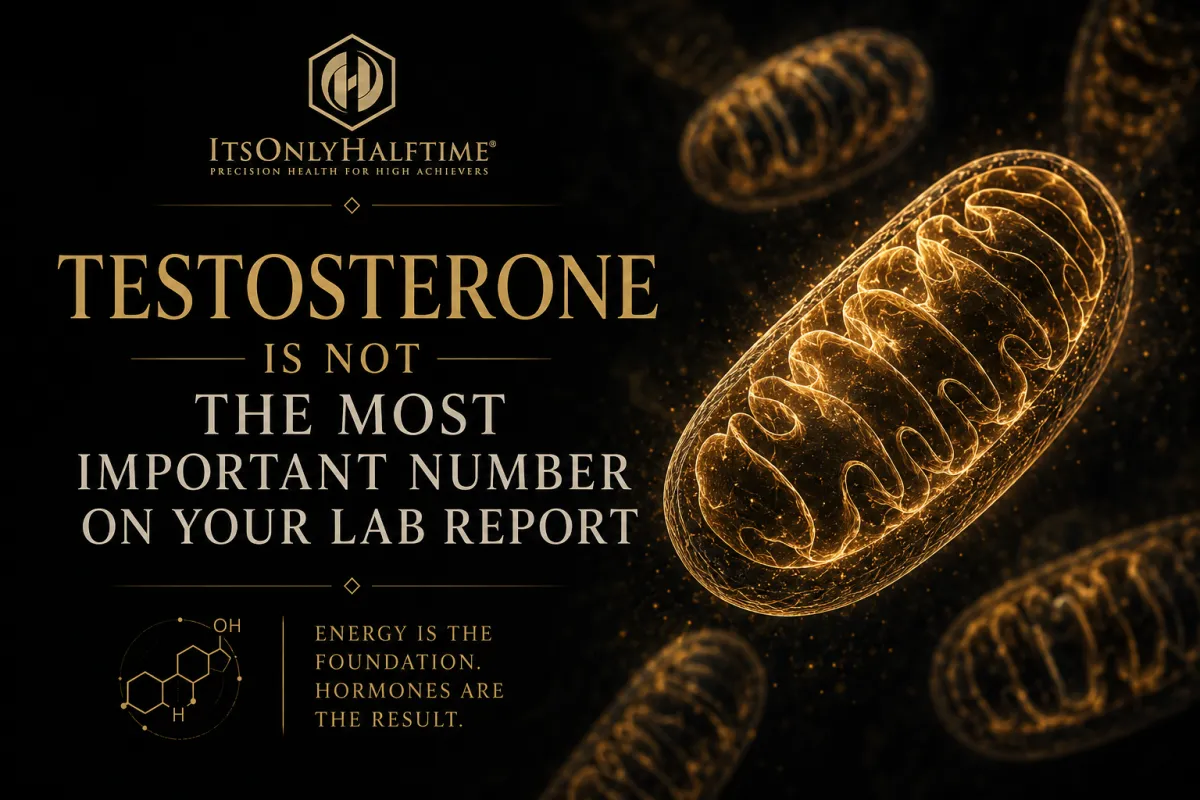
Testosterone is NOT the Most Important Number on your Lab Report
The Number Men Chase — And the Factory They Ignore
Why testosterone is built inside your cells, why the number on your lab report is the least important part of the story, and why so many men on TRT feel great for ninety days and then stall.
By Dr. Andreas Boettcher, D.C., CFMP, B.S. Health/Exercise Science
3x Ironman Triathlete, Master's Men's Physique Competitor & Medication FREE at 56
I talk to men every single day who are chasing a number.
They've read the article, listened to the podcast, seen the ad. They walk in with a lab report in hand, a single value circled in red — total testosterone — and a plan already formed in their head: get that number up. Sometimes they've already started TRT. And here's the part that should stop every man in his tracks: most of them felt fantastic for a while. More energy. Better workouts. Sharper focus. And then, somewhere around the two- or three-month mark, it plateaued. The magic faded. The fatigue crept back. The drive dulled.
They come to me confused, because the number on the new lab report looks great. So why do they feel like they're running on fumes again?
Because they fixed the reading on the gauge without ever fixing the engine. And that engine — the actual factory where testosterone is manufactured — is something almost no one ever told them about. It's your mitochondria.
THE IOH FRAME
Your body has an inner pharmacy. Testosterone, energy, and drive are made — not borrowed. When you only supply the hormone from the outside, you never repair the machinery that's supposed to make it on the inside. That's why the outside-in approach so often plateaus.
Testosterone Is Not Delivered. It's Manufactured.
Let's clear up the single biggest misconception in men's health.
Testosterone isn't something your body simply "has" or "runs out of" like fuel in a tank. It's a product — one that has to be built, molecule by molecule, through a precise manufacturing process called steroidogenesis. And the first, most critical, rate-limiting step of that entire process happens inside the mitochondria.
Here's how it actually works. Inside the Leydig cells of the testes, the raw material for testosterone is cholesterol. Yes — cholesterol, the molecule men have been taught to fear, is the parent building block of every steroid hormone you make. But cholesterol sitting in the cell does nothing on its own. It has to be transported into the mitochondrion, across the outer membrane and onto the inner membrane, by a specialized shuttle called theStAR protein(steroidogenic acute regulatory protein). This transport step is the true bottleneck of testosterone production. Nothing downstream happens until cholesterol makes it inside.
Once inside, on that inner mitochondrial membrane, an enzyme calledCYP11A1performs the first transformation — converting cholesterol into pregnenolone, the master precursor from which testosterone, DHEA, and every other steroid hormone eventually flows. From there the pathway continues through a relay of enzymes, some inside the mitochondria and some in the surrounding cell, each step handing the molecule to the next like a bucket brigade until testosterone is finally produced.
Read that again, because it changes everything:the very first and most important step of making testosterone happens inside your mitochondria.If your mitochondria are damaged, inflamed, energy-starved, or few in number, that assembly line slows down — no matter how badly you want the finished product. You cannot out-supplement, out-inject, or out-willpower a broken factory.
Why Healthy MitochondriaAreHealthy Hormones
Most men think of mitochondria — if they think of them at all — as the "powerhouse of the cell" from a half-remembered biology class. That's true, but it dramatically undersells what's happening.
Mitochondria produce ATP, the energy currency that powers every function in your body — muscle contraction, brain activity, immune defense, and, critically, the energy-intensive work of manufacturing hormones. Steroidogenesis is not free. Building testosterone from cholesterol is a demanding, ATP-hungry process. So the same organelle that powers the factory also houses the factory's first assembly line. When mitochondrial function declines, you lose on both fronts at once: less energy to run the process, and a damaged site where the process begins.
This is why mitochondrial health and testosterone are inseparable. They aren't two problems — they're one. A man with sluggish, damaged mitochondria will have low energy, poor recovery, brain fog, stubborn fat,andlow testosterone, and he'll wonder why he has four problems when he really has one root cause wearing four masks.
Three things determine how well this system runs. How many mitochondria you have— more capacity means more output. How well each one functions— a damaged mitochondrion leaks energy and produces destructive free radicals instead of clean power. And how efficiently your body clears out and replaces the broken ones— a process called mitophagy, your cellular maintenance crew. Age, stress, and the modern lifestyle degrade all three at once. And when they go, your hormonal factory goes with them.
The Cofactors: Why the Factory Needs More Than Cholesterol
Here's something the "just raise your testosterone" crowd never mentions. Steroidogenesis isn't a single switch — it's an enzymatic assembly line, and every enzyme on that line requires cofactors to function. Miss the cofactors, and the line stalls even when raw materials are abundant.
The enzymes that build testosterone are hungry for specific nutrients: magnesium, without which ATP itself cannot function — and most men are deficient. Zinc, a direct player in testosterone production and a regulator of the enzyme that converts testosterone to estrogen. B vitamins, which serve as essential cofactors throughout the energy-production machinery that powers the whole process. CoQ10, a critical component of the electron transport chain that generates the ATP steroidogenesis depends on — and whose production declines with age and is depleted by statin drugs.Vitamin D, which functions as a steroid hormone in its own right and is tied directly to healthy testosterone levels. Iron and selenium, needed for the electron transport chain and antioxidant defense that protect the factory from its own exhaust.
This is the deeper truth: your body doesn't just need thei ngredient (cholesterol). It needs a fully staffed, fully supplied, well-maintained factory to turn that ingredient into the finished hormone. Chronic nutrient depletion — from poor diet, gut dysfunction, medication, and stress — starves that factory quietly, for years, long before a lab number ever flags it.
Why the Number on Your Lab Report Is the Least Important Part
Now to the mistake I watch men make over and over.
They fixate on one number — total testosterone — as if it were a scoreboard. But that single value tells you almost nothing about what's actually happening. Here's why.
A large portion of your total testosterone is bound up and biologically inactive, tethered to a protein called SHBG. What matters far more is your free testosterone — the fraction actually available to your tissues. A man can have a "normal" total testosterone and be functionally deficient because his free testosterone is on the floor. The number looked fine; the reality wasn't.
Then there's what your body does with the testosterone it makes. Some of it converts to estrogen through an enzyme called aromatase — a process accelerated by excess body fat and inflammation. So a man can raise his testosterone and simply produce more estrogen, feeling worse instead of better. Meanwhile, the surrounding metabolic picture — fasting insulin, thyroid function, inflammation, cortisol — dictates whether the entire hormonal system can even work. High insulin drives down SHBG and wrecks the whole environment. A sluggish thyroid tanks the metabolic rate the whole system runs on. Chronic inflammation suppresses the signaling from the brain that tells the testes to produce in the first place.
Testosterone doesn't operate as a lone number on a page. It operates as one output of an entire system— a system built on mitochondrial energy, driven by cofactors, regulated by metabolism, and modulated by inflammation. Chasing the number in isolation is like judging a factory's health by staring at one gauge while the machines behind it are rusting.
This is exactly why so many men plateau on TRT. Supplying testosterone from the outside can move the gauge and, for a while, mask the symptoms. But it does nothing to repair the mitochondria, replace the missing cofactors, calm the inflammation, or fix the insulin resistance underneath. The root causes are still there — untouched. So the body adapts, the honeymoon ends, and the man is left dependent on a therapy that treated his symptom and ignored his cause. He didn't fix his engine. He just installed a louder speedometer.
The Habits That Are Quietly Destroying Your Factory
Here's the part that should light a fire, because most of what damages mitochondria is self-inflicted — and therefore fixable. Every day, ordinary choices are grinding down the very factory these men are desperate to restart.
Chronic poor sleep. Your mitochondria do their heaviest repair and antioxidant cleanup at night. Every hour of sleep you steal is an hour the maintenance crew doesn't clock in. Chronic short sleep degrades nearly every measurable mitochondrial parameter — and, not coincidentally, crushes morning testosterone. There is no supplement that buys back chronically stolen sleep.
Ultra-processed food and constant grazing. Seed oils oxidized at high heat damage mitochondrial membranes directly. Eating around the clock — late nights, no fasting window — denies mitochondria the metabolic downtime that triggers them to repair and regenerate. A diet of processed convenience food starves the factory of the exact cofactors it needs while flooding it with the damage it can't keep up with.
Sedentary living. Exercise is the single most powerful signal to build new mitochondria. Its absence is a signal too — the body downsizes a factory it doesn't think you need. A man who sits all day is quietly telling his cells to reduce capacity, year after year.
Chronic, unrelenting stress. Sustained high cortisol drives oxidative damage straight into mitochondrial DNA and suppresses the master switch that builds new mitochondria. The always-on, never-recovering executive lifestyle isn't just mentally taxing — it's cellularly corrosive, and it's directly suppressing the brain signaling that tells the testes to produce.
Alcohol is a direct mitochondrial toxin and it wrecks sleep architecture on top of it — a double hit to the factory and its night shift. The nightly drinks so many high-performing men use to "wind down" are quietly dismantling the machinery they need most.
Visceral fat and insulin resistance. Excess belly fat is metabolically active tissue that pumps out inflammation and accelerates the conversion of testosterone to estrogen. It's not just a symptom of low testosterone — it actively drives the problem deeper, creating a spiral where low T promotes fat, and fat suppresses T.
Smoking and vaping. Both directly poison the electron transport chain — the core of ATP production. You're literally suffocating the factory's power supply.
None of this is meant to shame. It's meant to hand back control. Because if your own habits are what damaged the factory, then your own habits are also the most powerful tool you have to rebuild it — no prescription required.
The Real Path Forward
The good news buried in all of this is enormous: the most powerful interventions for mitochondrial health cost nothing. Consistent training. Real sleep. Morning sunlight. Whole foods that supply the cofactors. Stress recovery that actually happens. These aren't hacks — they're the maintenance the factory was always designed to receive, and they work because they address the root instead of the readout.
This is the entire philosophy behind the Wealthy Body Protocol™. Rather than chase a number, we work to understand and repair the system underneath it — the mitochondrial function, the cofactor status, the metabolic environment, and the hormonal picture in full. When the factory is rebuilt and properly supplied, it does what it was designed to do: produce. And the results hold, because nothing was masked — it was fixed.
The Bottom Line
Low testosterone in the second half of life is rarely a testosterone problem. It's an energy problem, a mitochondrial problem, a root-cause problem — showing up as low hormones, low drive, and stubborn fat. The pharmaceutical treadmill treats the number and buys you a few good months. Root-cause work rebuilds the machine that produces the number, and gives you back the years.
Stop chasing the gauge. Rebuild the engine.
Your best years aren't behind you. Your physiology just needs to be rebuilt from the inside out.
⚡️ Ready To Take Charge of Your Health With the Most Comprehensive Natural Approach to Mens Health?
If you'd like to go deeper — to uncover the root causes behind your energy, hormones, metabolism, and performance — I invite you to book a complimentary consultation.
Together, we'll review your health history and goals and determine if our Wealthy Body Protocol based on your lab analysis, genetics, and lifestyle data is right for you!
👉Click here to apply: limited clients accepted each quarter
To learn more about our Wealthy Body Protocol and success stories visit www.ItsOnlyHalftime.com/wbp, where we help men like you turn your second half into your best half naturally!
Finish Strong,
Dr. Andreas
Still Kickin' A** Medication Free at 56 Despite What the "Narrative" Would Like You To Believe!

Medical Disclaimer:
The information provided in this article is for educational and informational purposes only and is not intended as medical advice. It should not replace professional consultation, diagnosis, or treatment. Always consult your healthcare provider before making any changes to your health regimen or lifestyle.