

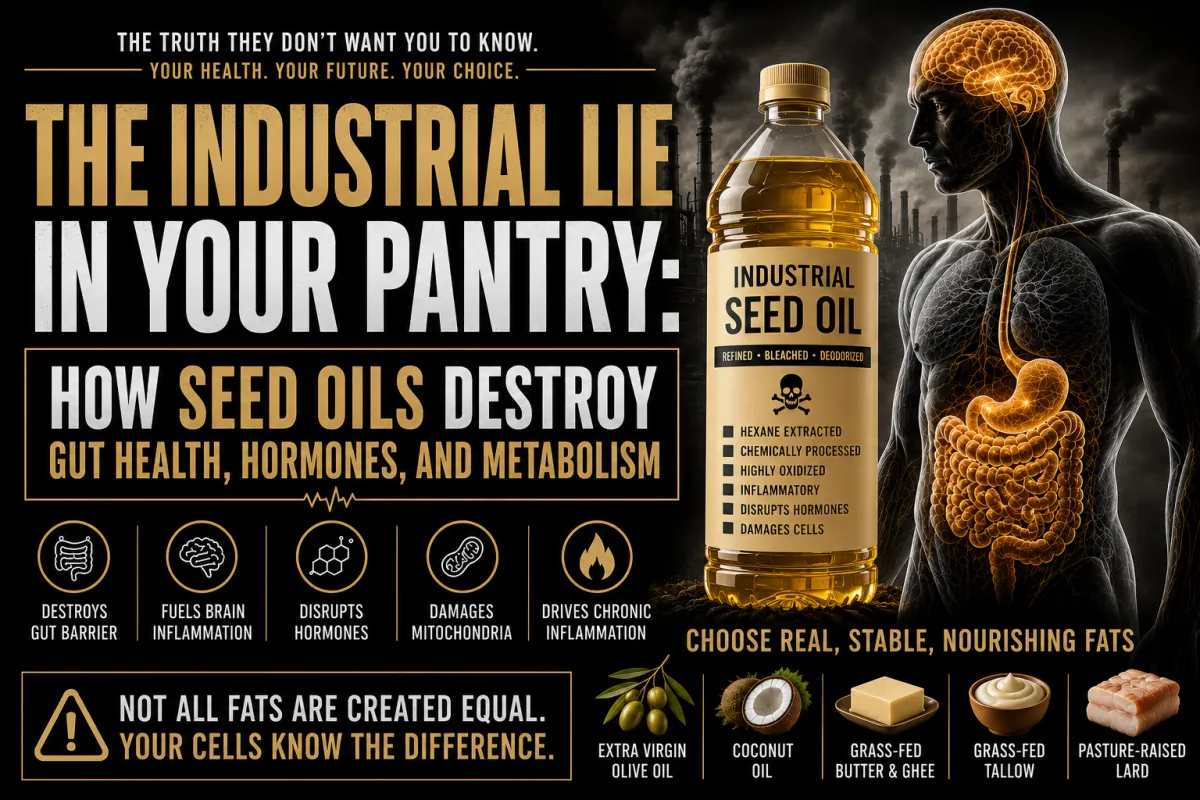
The Industrial Lie in Your Pantry: How Seed Oils Destroy Gut Health, Hormones, and Metabolism
By Dr. Andreas Boettcher, D.C., Functional Medicine, B.S. Health/Exercise Science
3x Ironman Triathlete, Master's Men's Physique Competitor & Medication FREE at 56
A Reminder Of How These Poisons Are Produced And Sold To Human Beings
Recent studies continue to show the alarming effects of consuming seed oils — canola, soybean, sunflower, corn, cottonseed, safflower, grapeseed, rice bran. These oils are everywhere in processed food, restaurant kitchens, hospital cafeterias, gym smoothie bars, and the "heart healthy" aisle of every grocery store in America. They are also being linked to a stunning list of chronic conditions: obesity, type 2 diabetes, fatty liver disease, cardiovascular disease, neurodegenerative disorders, depression, and gut dysfunction.
We have been told for seventy years that seed oils are a healthier option than the fats our great-grandparents used. The opposite is true. These oils are industrially processed, chemically extracted, oxidatively unstable, and biologically disruptive in a way that real food has never been.
Choosing healthier fats — extra virgin olive oil, coconut oil, grass-fed tallow, lard from pasture-raised pigs, ghee, butter from grass-fed cows — can radically change the trajectory of your long-term health. But most people will not change. Because seed oils do not produce an immediate, visible response. You don't wake up the next morning with diabetes. You don't crash after a meal cooked in sunflower oil the way you crash after a sugar bomb. The damage is subclinical, cumulative, and operating at the level of your cellular architecture, not your blood glucose.
That is what makes them so dangerous.
The Half-Life Problem: You Are Walking Around With Three Years Of Old Oil In Your Cells
Linoleic acid — the dominant polyunsaturated fat in seed oils — has a half-life of approximately one to two years in human adipose tissue. Some estimates suggest the body requires three to four years to fully equilibrate to a dietary change in linoleic acid intake. That means right now, you are walking around with oxidized fats from meals you ate two, three, four years ago integrated into your cellular architecture.
Research published in the journal Advances in Nutrition documented that linoleic acid concentrations in the adipose tissue of American adults have more than doubled — by 136 percent — over the last half century, directly tracking the explosion of seed oil consumption in the U.S. food supply. We are now the population with the highest linoleic acid load in human history, and we are also the sickest, fattest, most metabolically broken population in human history. That is not a coincidence.
The damage accumulates quietly. For days, weeks, months, years. And then at some point the inflammation becomes systemic enough, the mitochondrial function compromised enough, the hormonal signaling disrupted enough — that you have a condition. And the condition gets a name. Your blood pressure is high. Or your A1C is creeping. Or your liver enzymes are elevated. Or your testosterone collapsed. And the name gets a drug. Nifedipine. Metformin. Statins. Losartan. Testosterone replacement.
Nobody asks what was in the cooking oil. You just continue perishing.
How Seed Oils Are Actually Made
Before we get into the gut, the brain, the hormones — let me remind you what these substances actually are at the level of manufacturing. Because if you understood the process, you would never again call this stuff "food."
Step 1: Collect industrial crop waste — cotton seeds, soybeans, corn, rapeseed, sunflower seeds.
Step 2: Extract the oil using hexane — a petroleum-derived solvent also used in glue, varnish, and degreasers.
Step 3: Heat the slurry to extreme temperatures to drive off the hexane. This destroys natural antioxidants and begins oxidizing the oil before it ever leaves the factory.
Step 4: Treat with phosphoric acid or another caustic agent to "degum" the oil — strip out phospholipids and remaining cellular debris.
Step 5: Neutralize with sodium hydroxide (lye) to remove free fatty acids.
Step 6: Bleach with activated clay to remove the grey, rancid color the oil has developed by this point.
Step 7: Deodorize under vacuum at 400 to 500 degrees Fahrenheit to remove the fishy, rancid smell — a process that creates trans fats and 3-MCPD esters (recognized contaminants).
Step 8: Add synthetic antioxidants (TBHQ, BHA, BHT) to prevent immediate spoilage on the shelf.
Step 9: Bottle it, put a smiling heart on the label, market it as "vegetable oil."
Step 10: Pay enough lobbying money and advertising spend to call it "heart healthy" despite requiring nine chemical processes to be remotely edible.
Congratulations. You've created a substance that did not exist in the human food supply before approximately 1900. That requires petroleum solvents and industrial bleaching to produce. That oxidizes inside your body. That integrates into your cell membranes for 600 plus days. That generates inflammation for years.
But at least it's from plants. So it must be healthy.
What Seed Oils Do To The Gut: The Mechanism Most Doctors Have Never Been Taught
This is where the conversation gets serious. Because when we talk about seed oils, most of the popular discussion stops at "they cause inflammation." That is true, but it is the surface. The deeper truth is that seed oils are doing damage at the level of the gut microbiome, the gut barrier, the gut-brain axis, and the entire endocrine signaling system that originates in the intestinal tract.
Your gut is not a passive tube. It is an endocrine organ, an immune organ, and a neurological organ. It produces somewhere between 80 and 90 percent of your serotonin. It manufactures the satiety hormones that tell your brain when to stop eating. It houses 70 percent of your immune system. It hosts trillions of bacteria whose metabolites directly regulate your blood sugar, your blood pressure, your mood, and your inflammatory tone.
Seed oils disrupt every single one of these functions.
Seed Oils Cause Dysbiosis — They Rearrange The Microbiome In A Pathogenic Direction
A 2025 mechanistic review published in the journal Advances in Redox Research laid out something extremely important: linoleic acid interferes with the metabolism of colonocytes (the cells lining your colon) in a way that raises oxygen levels in the gut lumen.
This matters enormously. The healthy gut is an anaerobic environment — almost no free oxygen. The beneficial bacteria that thrive there (Faecalibacterium prausnitzii, Roseburia, Eubacterium rectale, Akkermansia muciniphila) are obligate anaerobes. They cannot survive in the presence of oxygen.
When linoleic acid damages colonocyte mitochondria and raises gut oxygen, these beneficial anaerobes die off. In their place, facultative anaerobes and pathogenic bacteria proliferate — including LPS-producing gram-negative organisms in the Proteobacteria phylum. This is the signature of dysbiosis: loss of diversity, loss of beneficial keystone species, overgrowth of inflammatory pathogens.
Multiple studies have now demonstrated that diets high in omega-6 seed oils reduce beneficial Bifidobacterium and Lactobacillus populations while expanding pro-inflammatory genera. The gut becomes ecologically broken.
Seed Oils Crash Short-Chain Fatty Acid Production
Short-chain fatty acids — butyrate, propionate, and acetate — are the metabolic currency of a healthy gut. They are produced when beneficial bacteria ferment dietary fiber, and they are not optional for human health. They are essential.
Butyrate specifically is the preferred fuel source of the colonocyte itself. The cells lining your colon do not primarily run on glucose. They run on butyrate. Without butyrate, the colon literally starves. Butyrate also maintains the tight junction proteins between intestinal cells (the literal physical barrier preventing "leaky gut"). It acts as a histone deacetylase inhibitor, regulating gene expression in an anti-inflammatory direction. It stimulates the secretion of GLP-1 and PYY, the satiety hormones. It activates GPR109A receptors that suppress inflammation. And it crosses the blood-brain barrier, providing anti-inflammatory and neuroprotective effects in the brain.
When seed oils drive dysbiosis and wipe out Faecalibacterium prausnitzii, Roseburia, and the other butyrate-producing keystone species, butyrate production collapses.
The colonocytes lose their fuel. The tight junctions weaken. The satiety signals get quieter. The brain loses its anti-inflammatory protection. This is the foundation of nearly every chronic inflammatory disease.
Seed Oils Cause Leaky Gut And Metabolic Endotoxemia
Once the gut barrier weakens, you get a phenomenon called metabolic endotoxemia — the low-grade, chronic translocation of bacterial fragments (specifically lipopolysaccharide, or LPS) from the gut into the bloodstream.
LPS is the outer membrane component of gram-negative bacteria. When it leaks into circulation, it binds to Toll-like receptor 4 (TLR4) on immune cells throughout the body, triggering the master inflammatory pathway. This is the inflammation behind insulin resistance. Behind type 2 diabetes. Behind cardiovascular disease. Behind non-alcoholic fatty liver disease. Behind Alzheimer's. Behind depression. Behind autoimmune flares.
Studies have shown that diets high in omega-6 vegetable oils shift the microbiome toward LPS-producing bacterial populations, increasing the inflammatory endotoxin burden. Meanwhile, omega-3 fatty acids and saturated fats from real food (like coconut and grass-fed butter) tend to reduce LPS translocation. This is the opposite of what we have been told for fifty years.
LPS in circulation activates ceramide synthesis — lipid molecules that directly interfere with insulin receptor signaling in muscle and liver cells. This is one of the major mechanistic links between gut dysbiosis and insulin resistance. Your blood sugar problem may have started in your colon. Specifically, it may have started in your cooking oil.
Seed Oils Disrupt Gut Hormone Signaling — Including GLP-1, PYY, And CCK
This is where the gut-brain axis truly breaks down. The enteroendocrine cells lining your intestine produce a suite of hormones that travel through both the bloodstream and the vagus nerve to control appetite, satiety, gastric emptying, insulin release, and even mood.
GLP-1, the satiety hormone now being mimicked by Ozempic, Wegovy, and Mounjaro. PYY, which terminates the meal-eating response. CCK, which slows gastric emptying and signals fullness. And ghrelin, the hunger hormone produced in the stomach.
Short-chain fatty acids — especially butyrate and propionate — directly stimulate GLP-1 and PYY release via FFAR2 and FFAR3 receptors on the enteroendocrine L-cells.
When seed oils kill the butyrate-producing bacteria, GLP-1 and PYY release decline. Your natural satiety signaling goes quiet. You eat past full. You crave more. The pharmaceutical industry's solution is to inject a synthetic version of GLP-1 at $1,300 a month. The biological solution is to stop poisoning the gut bacteria that were producing it for free.
Meanwhile, LPS-driven inflammation in the vagal afferent neurons impairs the transmission of whatever satiety signals do get produced. The brain stops hearing the gut. Hunger dysregulation becomes the new baseline. Weight gain becomes inevitable.
Seed Oils Damage The Vagus Nerve And The Gut-Brain Axis
The vagus nerve is the largest cranial nerve and the primary information highway between your gut and your brain. Eighty percent of vagal fibers are afferent — meaning they carry information from gut to brain, not the other way around. Your gut is talking to your brain constantly.
The vagus nerve expresses TLR2, TLR3, TLR4, and TLR7 — the same toll-like receptors that respond to LPS. When metabolic endotoxemia is chronic, the vagal afferent neurons themselves become inflamed. This impairs satiety signaling from gut to hypothalamus. It impairs parasympathetic tone, the "rest and digest" branch of the autonomic nervous system. It impairs heart rate variability. It impairs mood regulation via serotonin and GABA signaling. And it impairs cognitive function and memory consolidation.
In long-term studies, this chronic vagal inflammation has been implicated in the development of neurodegenerative diseases including Parkinson's and Alzheimer's. The gut-brain axis is not metaphorical. It is a physical, anatomical, biochemical bridge — and seed oils corrode it from both ends.
Seed Oils Cripple The Mitochondria In Every Cell They Touch
The omega-6 linoleic acid molecule gets incorporated into cardiolipin — a phospholipid that lives exclusively in the inner mitochondrial membrane, where it organizes the electron transport chain and enables ATP production. The more linoleic acid you eat, the more linoleic acid ends up in your cardiolipin.
Cardiolipin loaded with linoleic acid is extremely vulnerable to peroxidation. When it oxidizes, it produces 4-hydroxynonenal (4-HNE) and malondialdehyde (MDA) — reactive aldehydes that damage proteins, DNA, and other lipid membranes. The mitochondria stop producing energy efficiently. ATP output falls. Reactive oxygen species rise. The cell shifts toward an inflammatory, glycolytic, dysfunctional state.
In the gut, this means colonocytes can't run on butyrate anymore even when butyrate is present, because the mitochondrial machinery is broken. In the liver, this is the mechanism of non-alcoholic steatohepatitis (NASH). In the brain, this is part of the picture in Alzheimer's. In the muscle, this is sarcopenia and insulin resistance. The same mechanism. Different tissue.
The Oxidized Linoleic Acid Metabolites: OXLAMs
When linoleic acid oxidizes — and it oxidizes readily, especially when heated — it produces a class of compounds called oxidized linoleic acid metabolites, or OXLAMs. These include 9-HODE, 13-HODE, 9-oxoODE, 13-oxoODE, and 4-HNE.
OXLAMs are not benign. They damage cell membranes throughout the body. They activate inflammatory and pain pathways (including TRPV1, the capsaicin and pain receptor). They are elevated in patients with non-alcoholic steatohepatitis and correlate with disease severity. They are associated with neurodegenerative conditions when accumulated in brain tissue. They form covalent adducts with proteins, permanently inactivating them. And they are present in every bottle of seed oil on the shelf — and concentrate further when those oils are heated for frying.
When you eat food cooked in seed oil, you are not just eating linoleic acid. You are eating pre-oxidized linoleic acid metabolites that will immediately go to work damaging your tissues. Then your body produces more OXLAMs internally from the linoleic acid stored in your fat. The damage compounds.
What This Looks Like Clinically — The Patient You Already Are
I've been in functional medicine for 33 years. I've run 415 plus biomarker panels, genetic blueprints, GI-MAPs, and hormone analyses on thousands of patients. Let me tell you what I see over and over again.
A man in his late 40s walks in. He's gained 25 pounds. His libido is a fraction of what it used to be. He has brain fog by 2 PM. He's bloated after meals, sleeps poorly, wakes up tired, has elevated blood pressure his doctor wants to medicate, an A1C of 5.8 that his doctor calls "fine," ALT and AST creeping up, hs-CRP at 3.2, total testosterone in the 300s.
His doctor tells him this is aging. It is not aging. It is the consequence of decades of seed oil exposure manifesting through every system I've described above. Gut dysbiosis leads to loss of butyrate, which leads to leaky gut, which leads to endotoxemia. Endotoxemia activates TLR4, which drives ceramide production, which drives insulin resistance. Insulin resistance drives low testosterone via increased aromatase and SHBG dysregulation, visceral fat, and fatty liver. Mitochondrial damage in muscle drives fatigue, sarcopenia, and low VO2 max. Vagal inflammation drives poor satiety, poor sleep, low HRV, and anxiety. OXLAM accumulation in the brain drives brain fog, slowed cognition, and low mood.
This is the high-performance metabolic breakdown I see in executive men every single week. And the conventional medical system addresses none of it. They put a name on the symptom. They prescribe the drug. The cooking oil never enters the conversation.
What To Do — The Wealthy Body Protocol Approach
If you've read this far, you understand why I am uncompromising on this issue with my clients. The intervention is not complicated. It is hard, because seed oils are everywhere — but it is not complicated.
Eliminate from your kitchen: canola, soybean, corn, sunflower, safflower, cottonseed, grapeseed, and rice bran oil. Margarine and buttery spreads. Most commercial salad dressings (read the label — the second ingredient is almost always soybean oil). Most commercial mayonnaise (same problem). Roasted nuts cooked in vegetable oil. Almost all packaged snack foods, crackers, and chips. Almost all restaurant food fried in fryer oil.
Replace with: extra virgin olive oil (high polyphenol, real oil from real fruit). Avocado oil (verify the source — many on the market are adulterated). Grass-fed butter and ghee. Coconut oil. Tallow from grass-fed beef. Lard from pasture-raised pigs. Duck fat.
Rebuild the gut by eliminating the offending oils as step one — without this, nothing else works. Eat real fiber from whole vegetables to feed the butyrate producers. Consume fermented foods (real sauerkraut, kefir, kimchi) to reseed the microbiome. Address dysbiosis directly with targeted protocols based on stool testing. Restore mitochondrial function with appropriate cofactors (CoQ10, magnesium, B vitamins, carnitine). Increase omega-3 intake from wild fish, grass-finished beef, and tested EPA/DHA supplementation to correct the omega-6 to omega-3 ratio.
Recognize the timeline. The half-life of linoleic acid in your tissue is one to two years. You did not get here in a week, and you will not undo it in a week. Three to four years of disciplined dietary change is what it takes to fully equilibrate your adipose tissue back to a healthy fatty acid profile. The shorter-term wins — sleep, energy, brain clarity, gut comfort, libido, body composition — typically begin in 30 to 90 days.
This is not a fad. This is not an opinion. This is biology. The seed oil industry is one of the most successful disinformation campaigns in modern history, and it has cost millions of people their health, their performance, their longevity, and their lives.
You can keep using them and continue perishing on schedule. Or you can change.
It really is that binary.
Remember, It's Only Halftime
I'm 56. I have an empty medicine cabinet. Single-digit body fat. Higher testosterone now than I had in my 30s. I survived a testosterone crash to 216 ng/dL, an autoimmune condition, emergency back surgery, and three Ironman finishes. I run a clinical practice, raise a family, travel internationally as a speaker, and play golf to a 6 handicap on the FSGA circuit.
I am not telling you this because I'm special. I am telling you because I rebuilt this body from a worse starting point than most of you have, and one of the first things I did was eliminate seed oils completely. Not "reduced." Not "limited." Eliminated. From my kitchen, from my supplements, from my restaurants when possible, from my life.
It is the cheapest, fastest, most powerful intervention available to you, and almost nobody is willing to do it because the food industry made it inconvenient.
You will not feel them. That is the danger. The damage runs on a 600-day timeline integrated into your cell membranes. By the time you feel it, you have a condition with a name and a drug.
Don't wait for that. It's only halftime. The second half is won or lost on the decisions you make right now — starting with what comes out of your pantry tonight.
⚡️ Ready To Take Charge of Your Health With the Most Comprehensive Natural Approach to Mens Health?
If you'd like to go deeper — to uncover the root causes behind your energy, hormones, metabolism, and performance — I invite you to book a complimentary consultation.
Together, we'll review your health history and goals and determine if our Wealthy Body Protocol based on your lab analysis, genetics, and lifestyle datais right for you!
👉Click here to apply: limited clients accepted each quarter
To learn more about our approach and success stories, visitwww.ItsOnlyHalftime.com, where we help men like you turn your second half into your best half naturally!
Finish Strong,
Dr. Andreas
Still Kickin' A** Medication Free at 56 Despite What the "Narrative" Would Like You To Believe!

Medical Disclaimer:
The information provided in this article is for educational and informational purposes only and is not intended as medical advice. It should not replace professional consultation, diagnosis, or treatment. Always consult your healthcare provider before making any changes to your health regimen or lifestyle.
References
1. DiNicolantonio JJ, O'Keefe JH. Omega-6 vegetable oils as a driver of coronary heart disease: the oxidized linoleic acid hypothesis. Open Heart. 2018;5(2):e000898.
2. Hooper L, et al. Effects of total fat intake on body fatness in adults. Cochrane Database of Systematic Reviews. 2020.
3. Marklund M, et al. Biomarkers of dietary omega-6 fatty acids and incident cardiovascular disease and mortality. Circulation. 2019;139(21):2422–2436.
4. Whelan J, Fritsche K. Linoleic acid. Advances in Nutrition. 2013;4(3):311–312.
5. Hodson L, Skeaff CM, Fielding BA. Fatty acid composition of adipose tissue and blood in humans and its use as a biomarker of dietary intake. Progress in Lipid Research. 2008;47(5):348–380.
6. Guyenet SJ, Carlson SE. Increase in adipose tissue linoleic acid of US adults in the last half century. Advances in Nutrition. 2015;6(6):660–664.
7. Mercola J, D'Adamo CR. Linoleic acid, mitochondria, gut microbiome, and metabolic health: a mechanistic review. Advances in Redox Research. 2025.
8. DiNicolantonio JJ, O'Keefe J. The importance of maintaining a low omega-6/omega-3 ratio for reducing the risk of autoimmune diseases, asthma, and allergies. Missouri Medicine. 2021;118(5):453–459.
9. Ramsden CE, et al. Use of dietary linoleic acid for secondary prevention of coronary heart disease and death: evaluation of recovered data from the Sydney Diet Heart Study and updated meta-analysis. BMJ. 2013;346:e8707.
10. Innes JK, Calder PC. Omega-6 fatty acids and inflammation. Prostaglandins, Leukotrienes and Essential Fatty Acids. 2018;132:41–48.
11. Cani PD, et al. Metabolic endotoxemia initiates obesity and insulin resistance. Diabetes. 2007;56(7):1761–1772.
12. Mani V, Hollis JH, Gabler NK. Dietary oil composition differentially modulates intestinal endotoxin transport and postprandial endotoxemia. Nutrition & Metabolism. 2013;10:6.
13. Bonaz B, Bazin T, Pellissier S. The vagus nerve at the interface of the microbiota-gut-brain axis. Frontiers in Neuroscience. 2018;12:49.
14. Tolhurst G, et al. Short-chain fatty acids stimulate glucagon-like peptide-1 secretion via the G-protein-coupled receptor FFAR2. Diabetes. 2012;61(2):364–371.
15. Cresci GA, Bawden E. Gut microbiome: what we do and don't know. Nutrition in Clinical Practice. 2015;30(6):734–746.
16. Marques FZ, Mackay CR, Kaye DM. Beyond gut feelings: how the gut microbiota regulates blood pressure. Nature Reviews Cardiology. 2018;15(1):20–32.
17. Furusawa Y, et al. Commensal microbe-derived butyrate induces the differentiation of colonic regulatory T cells. Nature. 2013;504(7480):446–450.
18. Mestdagh R, et al. Gut microbiota modulate the metabolism of brown adipose tissue in mice. Journal of Proteome Research. 2012;11(2):620–630.
19. Ramsden CE, et al. Lowering dietary linoleic acid reduces bioactive oxidized linoleic acid metabolites in humans. Prostaglandins, Leukotrienes and Essential Fatty Acids. 2012;87(4–5):135–141.
20. Mohajeri MH, et al. Relationship between the gut microbiome and brain function. Nutrition Reviews. 2018;76(7):481–496.
21. Rohr MW, et al. Negative effects of a high-fat diet on intestinal permeability: a review. Advances in Nutrition. 2020;11(1):77–91.
22. Bjørklund G, et al. Roles of dietary linoleic acid and its OXLAM derivatives in inflammation and metabolic disease. Nutrients. 2023;15(14):3129.
23. Vergallo A, et al. Microbiota-gut-brain axis: relationships among the vagus nerve, gut microbiota, obesity, and diabetes. Acta Diabetologica. 2023;60(8):1007–1017.
24. Schuster S, et al. Oxidized linoleic acid metabolites induce liver mitochondrial dysfunction, apoptosis, and NLRP3 activation in mice. Journal of Lipid Research. 2018;59(9):1597–1609.
25. Hennebelle M, et al. Effects of diets enriched in linoleic acid and its peroxidation products on brain fatty acids, oxylipins, and aldehydes in mice. Biochimica et Biophysica Acta — Molecular and Cell Biology of Lipids. 2018;1864(7):1206–1217.
26. Louis P, Flint HJ. Formation of propionate and butyrate by the human colonic microbiota. Environmental Microbiology. 2017;19(1):29–41.
27. Mosca A, Leclerc M, Hugot JP. Gut microbiota diversity and human diseases: should we reintroduce key predators in our ecosystem? Frontiers in Microbiology. 2016;7:455.
28. de Vos WM, et al. Gut microbiome and health: mechanistic insights. Gut. 2022;71(5):1020–1032.
29. Carrasco-Pozo C, et al. Stability and inflammatory potential of vegetable oils under thermal stress. Food Chemistry. 2020;313:126167.
30. Boutagy NE, et al. Dietary fat and gut bacterial metabolites in cardiometabolic disease. Trends in Endocrinology & Metabolism. 2016;27(6):407–419.
This article is for educational purposes and does not constitute medical advice. Consult your physician before making changes to your diet or supplement regimen.