


5 Blood Markers That Predict Your Next Decade — And Your Doctor Isn't Checking Them
By Dr. Andreas Boettcher, D.C., Functional Medicine, B.S. Health/Exercise Science
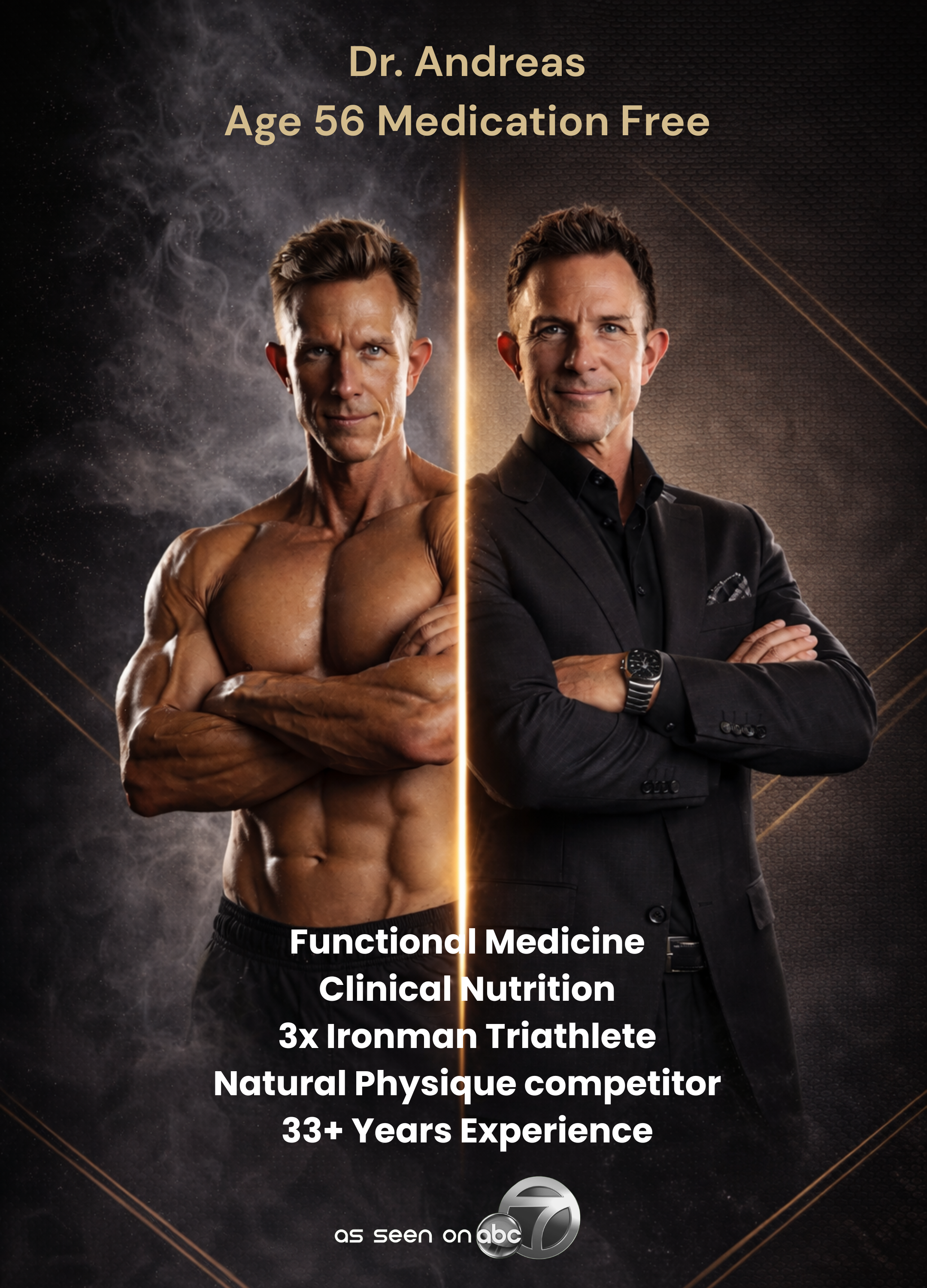
3x Ironman Triathlete, Master's Men's Physique Competitor & Medication FREE at 56
Let me be straight with you.
Your annual blood work is lying to you. Not intentionally — but by omission.
Every year, you sit in that exam room. They draw blood. You wait a few days. Your doctor calls and says the magic words: "Everything looks good."
And you go on about your life — carrying 30 extra pounds, crashing at 3pm, sleeping like garbage, wondering where the hell your drive went — because the numbers say you're "fine."
Here's the problem: those numbers are testing the wrong things.
The standard metabolic panel your doctor runs checks roughly 10–12 markers. It's designed to catch disease that already exists — not to predict or prevent the disease that's quietly building inside you right now. It's a rearview mirror on a car headed for a cliff.
At It's Only Halftime, we evaluate up to 415 biomarkers. That's not a typo. Four hundred and fifteen biological indicators that tell us not just where you are — but where you're heading.
Today, I want to give you the five markers — out of those 415 — that I believe are the single strongest predictors of what the next decade of your life will look like. Your doctor almost certainly isn't checking any of them.
Your Standard Lab Panel Was Built for Sick Care — Not Health Care
Let me put this in perspective.
The reference ranges on your lab report aren't based on optimal health. They're based on a statistical average of everyone who walked into that lab — including the overweight, the diabetic, the medicated, the chronically ill. That's the population your "normal" is derived from.
So when your doctor tells you your numbers are normal, what they're really saying is: you're no worse than the average American. And the average American male over 50 is overweight, on three or more prescriptions, and well on his way to a cardiovascular event, metabolic dysfunction, or both.
That's not a standard I accept for myself. And it shouldn't be one you accept either.
"Being 'normal' in a sick population isn't health. It's slow-motion decline with a lab coat's blessing."
Marker #1: Fasting Insulin — The Master Switch
If I could only test one marker for every man who walked through my door, this would be it.
Fasting insulin is the single most predictive marker of metabolic health — and it's almost never tested in a standard panel. Your doctor checks fasting glucose. Maybe A1C. But by the time glucose is elevated, insulin resistance has been silently running the show for years — sometimes a decade or more.
Think of it this way: glucose is the fire alarm. Insulin is the smoke. By the time the alarm goes off, the damage is already extensive.
Here's what your lab says is "normal": 2–25 mU/L.
Here's what optimal actually looks like: 2–5 mU/L.
That's a massive gap. A man walking around with a fasting insulin of 18 — well within the "normal" range — is already insulin resistant. His cells are becoming deaf to insulin's signal. His body is storing fat preferentially around the midsection. His testosterone production is being suppressed. His risk of type 2 diabetes, cardiovascular disease, and cognitive decline is climbing every single day.
And his doctor said everything looks good.
Marker #2: hs-CRP — The Silent Fire
High-sensitivity C-reactive protein is your body's smoke detector for chronic inflammation — and chronic inflammation is the upstream driver of nearly every degenerative condition plaguing men over 40.
Heart disease. Metabolic dysfunction. Hormonal suppression. Cognitive decline. Joint deterioration. All of them share one common accelerant: silent, systemic inflammation that doesn't produce obvious symptoms until it's done years of damage.
Standard "normal" range: < 3.0 mg/L.
Functional optimal: < 0.5 mg/L.
I've had men walk in with an hs-CRP of 2.5 — "perfectly normal" by their doctor's assessment — who were running a low-grade inflammatory cascade that was actively suppressing their testosterone, disrupting their sleep architecture, and accelerating vascular damage. Once we identified the sources — gut permeability, food sensitivities, oxidative stress — and addressed them at the root, inflammation dropped, and everything else began to normalize.
"Inflammation doesn't knock on the door. It picks the lock. And by the time you notice, it's been inside for years."
Marker #3: Homocysteine — The Cardiovascular Risk Hiding in Plain Sight
While your doctor is focused on total cholesterol — a marker that tells you almost nothing about actual cardiovascular risk — homocysteine is quietly signaling vascular damage, methylation dysfunction, and B-vitamin insufficiency.
Elevated homocysteine damages the endothelial lining of your blood vessels. It increases clotting risk. It impairs detoxification pathways. And it's directly correlated with cognitive decline, cardiovascular events, and all-cause mortality.
Standard "normal": 5–15 µmol/L.
Functional optimal: 5–7 µmol/L.
A man sitting at 12 µmol/L is technically "normal" and functionally compromised. His methylation pathways — the same pathways responsible for detoxification, neurotransmitter production, DNA repair, and hormone metabolism — are underperforming. And no one is looking.
This is one of the most correctable markers we test. Targeted B-vitamin support, methylation optimization, and lifestyle adjustments can bring homocysteine into optimal range within weeks. But you can't fix what you don't test.
Marker #4: DHEA-S — Your Biological Aging Clock
DHEA-sulfate is the most abundant steroid hormone in your body and serves as a precursor to both testosterone and estrogen. It's also one of the most reliable indicators of biological aging and adrenal reserve.
Here's the inconvenient truth: DHEA-S peaks in your mid-20s and declines steadily thereafter. By 50, most men are running at 30–40% of their peak levels. And that decline correlates directly with reduced immune function, increased body fat, decreased muscle mass, impaired cognitive performance, and — critically — reduced capacity to produce downstream hormones like testosterone.
Standard labs rarely test DHEA-S. When they do, the reference ranges are so broad they're nearly useless. A 50-year-old man with a DHEA-S of 120 µg/dL is technically "in range" but functionally depleted.
Optimal? I want to see DHEA-S in the upper quartile for a man's age — ideally 250–400 µg/dL for men in their 40s and 50s. That's the zone where the body has adequate raw material to support hormonal production, immune resilience, and recovery capacity.
Marker #5: ApoB — The Real Cholesterol Number
Let me tell you something that will probably frustrate you: total cholesterol is one of the most overused and misunderstood markers in all of medicine.
Men are put on statins every single day based on a total cholesterol number that tells their physician almost nothing about actual cardiovascular risk. Meanwhile, Apolipoprotein B — the protein that carries LDL particles into your arterial walls and drives atherosclerotic plaque formation — goes completely untested.
ApoB is a direct measurement of the number of atherogenic particles in your blood. Not the cholesterol content of those particles — the particles themselves. It's the difference between counting the number of cars on the highway versus measuring how much gas is in each car. The number of cars is what causes the traffic jam — and the plaque.
Standard "normal": < 130 mg/dL.
Functional optimal: < 80 mg/dL.
A man with a "perfect" total cholesterol of 195 can have a dangerously elevated ApoB — meaning he has a high number of small, dense LDL particles actively penetrating his arterial walls. His doctor celebrates the total number. The actual risk goes unaddressed.
Cole, one of our clients, came to us at 46 with a testosterone of 660 — already "good" by conventional standards. But his comprehensive panel revealed elevated inflammatory markers and metabolic inefficiencies no standard panel would have caught. Ninety days later? Testosterone climbed to 935. Triglycerides dropped 54%. Not because we guessed — because we measured what actually mattered.
Stop Waiting for Permission to Take Control of Your Health
Here's the hard truth: your doctor isn't going to order these tests. Not because they don't matter — but because the system isn't built for optimization. It's built for disease management. Insurance doesn't reimburse for "preventing the thing that hasn't happened yet." Seven-minute appointments don't allow for the conversation about what optimal actually looks like for your body.
So the question isn't whether these markers matter. The science is clear. The question is whether you're willing to stop outsourcing your health decisions to a system that wasn't designed to keep you at your best.
At It's Only Halftime, every client begins with a comprehensive evaluation of up to 415 biomarkers — including every marker on this list and hundreds more. We don't guess. We don't use population-based averages to define your ceiling. We use precision data to build a protocol designed for one person: you.
"The difference between a man who ages and a man who declines isn't genetics. It's information."
If something in this article resonated — if you've been told you're "fine" but you know damn well you don't feel fine — I want you to take one step.
Visit ItsOnlyHalftime.com. Take the Wealthy Body Scorecard. And find out what your biology is actually telling you — not what the standard panel is hiding from you.
Your second half doesn't have to look like everyone else's. But the first step is knowing your real numbers.
⚡️ Ready To Take Charge of Your Health With the Most Comprehensive Natural Approach to Mens Health?
If you'd like to go deeper — to uncover the root causes behind your energy, hormones, metabolism, and performance — I invite you to book a complimentary consultation.
Together, we'll review your health history and goals and determine if our Wealthy Body Protocol based on your lab analysis, genetics, and lifestyle data is right for you!
👉Click here to apply: limited clients accepted each quarter
To learn more about our approach and success stories, visit www.ItsOnlyHalftime.com, where we help men like you turn your second half into your best half naturally!
Finish Strong,
Dr. Andreas
Still Kickin' A** Medication Free at 56 Despite What the "Narrative" Would Like You To Believe!
Medical Disclaimer:
The information provided in this article is for educational and informational purposes only and is not intended as medical advice. It should not replace professional consultation, diagnosis, or treatment. Always consult your healthcare provider before making any changes to your health regimen or lifestyle.